
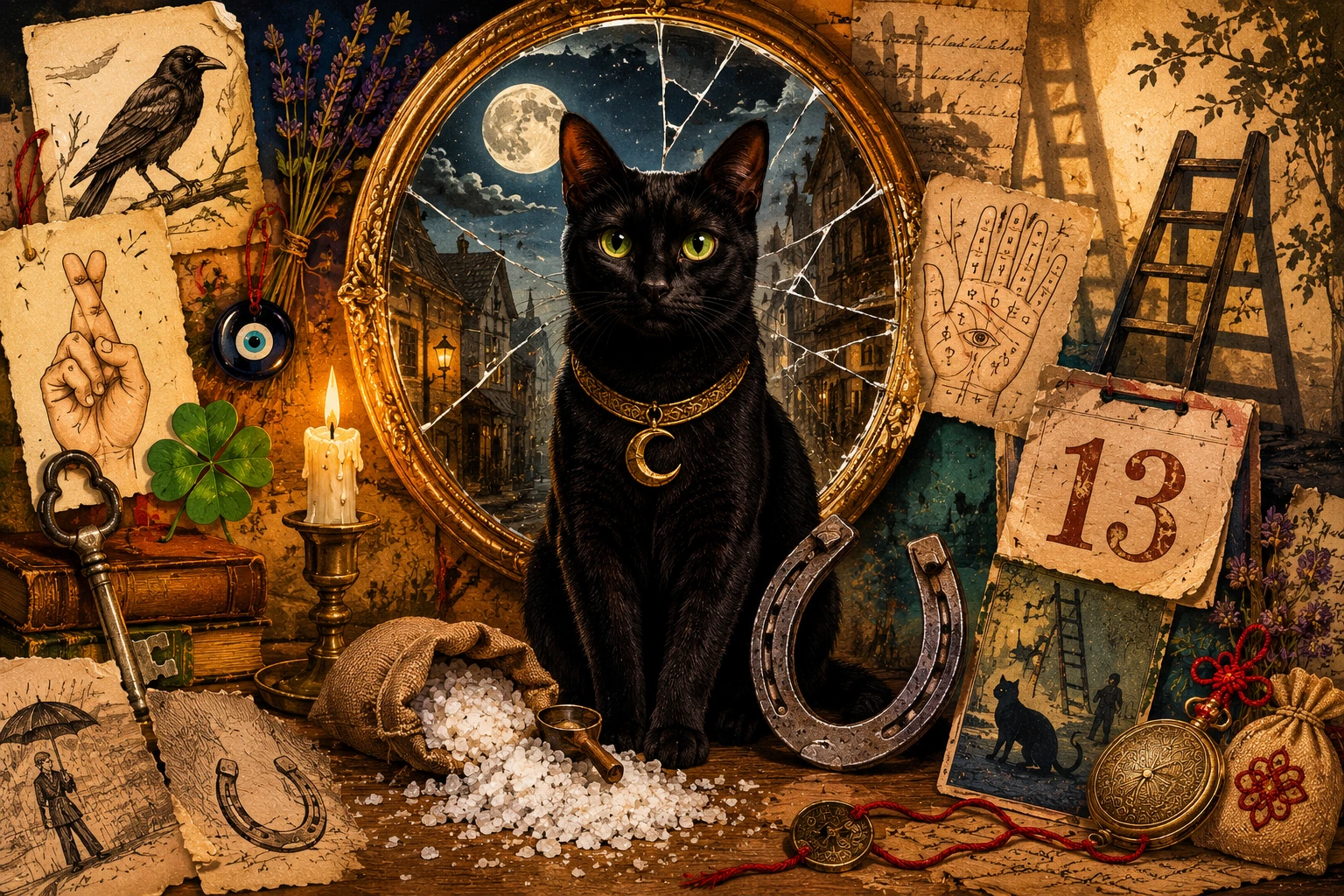
The History of Superstitions People Still Believe Today
Superstitions survive because they do something useful, even when they are not literally true. They give shape to uncertainty. They make danger feel manageable. They turn luck into something a person can touch, avoid, whisper, knock on, or carry in a pocket.
Many familiar superstitions are older than people think, but not always in the way people claim. Some have ancient roots. Some are only a few centuries old. Some have origin stories that sound convincing but are difficult to prove. Folklore often grows through repetition rather than written records.
That uncertainty is part of the story. Superstitions are not formal laws or official doctrines. They move through families, neighborhoods, trades, religions, and childhood warnings. They change as they travel.
A superstition may begin as a ritual, a joke, a religious fear, a safety habit, or a social rule. Later, the original reason fades. What remains is the gesture.
Knocking on Wood
Knocking on wood is one of the most familiar small rituals in everyday life. Someone says something hopeful, then taps a table, door, desk, or chair. The action is meant to prevent bad luck or avoid tempting fate.
The origin is often explained through ancient tree worship. According to this version, people once believed spirits lived in trees, so touching wood asked those spirits for protection. Another explanation links wood to the Christian cross. Both stories are widely repeated, but the evidence is not firm.
History.com notes that there is little agreement about the true origin of knocking on wood. It may be connected to older beliefs about trees, Christian symbolism, or later children’s games in which touching wood made a player “safe.” (History)
That uncertainty does not make the superstition less interesting. It shows how a simple gesture can gather many meanings over time. Wood can mean nature, protection, safety, religion, or luck.
The ritual survives because it is easy. It takes one second. It costs nothing. It lets a person speak hope aloud while pretending not to be too confident.
Friday the 13th
Friday the 13th feels like an ancient curse, but its familiar modern form is not as old as many assume. The number 13 and the day Friday both had unlucky associations in parts of Christian Europe. Over time, they combined into one superstition.
The number 13 was often viewed with suspicion because it followed 12, a number associated with order and completeness. There were 12 months, 12 zodiac signs, and, in Christian tradition, 12 apostles. The Last Supper had 13 people present, with Judas often counted as the unlucky extra guest.
Friday also carried dark associations in Christian tradition because Jesus was crucified on Good Friday. When the unlucky number and unlucky day came together, the result felt especially ominous.
Britannica notes that the Friday the 13th superstition was first written about nearly 200 years ago in France, with references appearing in 1834. (Encyclopedia Britannica) That makes the specific superstition much newer than many dramatic origin stories suggest.
The belief survives because calendars give it regular life. It returns once or twice most years. Each return renews the story.
Broken Mirrors and Seven Years of Bad Luck
Breaking a mirror still makes some people pause. Even those who do not truly believe in the superstition may feel a small chill when glass cracks and a reflection splits.
The belief is usually traced to ancient ideas about reflections and the soul. In some ancient societies, a reflected image was not treated as a meaningless optical effect. It could seem connected to the person’s life, identity, or spiritual state.
The University of South Carolina explains that the broken mirror superstition is often linked to ancient Greek and Roman beliefs about reflected images having mysterious powers. The “seven years” part is commonly tied to Roman ideas about cycles of bodily renewal. (University of South Carolina)
The superstition makes emotional sense. A mirror shows the self. When it shatters, it looks like damage to identity. The broken object becomes a symbol of broken fortune.
It also survives because mirrors were once expensive. A broken mirror was not a small loss. Turning that loss into a warning gave the accident moral weight.
Black Cats Crossing Your Path
Black cats have carried very different meanings in different cultures. In some places, they have been lucky. In others, especially in parts of Europe and North America, they became linked with witchcraft, darkness, and bad luck.
Britannica explains that the unlucky image of black cats became especially strong in Europe and the Americas from roughly the 14th to 18th centuries. During witch hunts and trials, black cats were often associated with witches or familiars, which were believed to be spirits or demons serving witches. (Encyclopedia Britannica)
The cat itself did nothing wrong. The superstition came from fear, religion, folklore, and the larger persecution of people accused of witchcraft. Black animals were easy to load with symbolic meaning because black was often associated with night, death, secrecy, or evil.
The belief survived because cats are independent and mysterious to human eyes. They move silently. Their eyes shine in the dark. They appear and disappear on their own terms.
A black cat crossing a road became a tiny drama. The animal became a sign, even when it was only going somewhere.
Throwing Salt Over the Shoulder
Spilling salt is often said to bring bad luck. The traditional cure is to throw a pinch over the left shoulder. The gesture is meant to blind or drive away evil.
Salt was once extremely valuable. It preserved food, flavored meals, and played roles in religious and ritual life. To spill it was not just messy. It could be wasteful.
Britannica describes the custom of throwing salt over the left shoulder as an old superstition meant to ward off evil spirits. The salt is imagined as blinding them or blocking harm. (Encyclopedia Britannica)
The left side has often been associated with danger or misfortune in European folklore. The word “sinister” itself comes from the Latin word for left. That old suspicion made the left shoulder a natural direction for danger to gather.
The ritual survives because it transforms a small accident into a small repair. Something bad happens. A person does something quick. Order is restored.
Walking Under a Ladder
Walking under a ladder is unlucky in many modern superstitions. The practical reason is obvious. It can be unsafe. A tool might fall. The ladder might shift. Someone working above could be startled.
But the superstition also gathered symbolic meanings. A ladder leaning against a wall forms a triangle. In Christian interpretation, some later explanations connected the triangle with the Holy Trinity, making it improper or dangerous to pass through it.
Other origin stories claim ancient Egyptian roots, because triangles had sacred meaning in Egyptian culture. Such explanations are often repeated, but they should be treated carefully. The safety explanation may be more convincing than any single ancient origin story.
This is one of the clearest cases where superstition may have preserved practical caution. People did not need a physics lesson to avoid danger. They needed a rule they would remember.
“Do not walk under a ladder” is good safety advice, even without spirits or sacred triangles.
The Evil Eye
The evil eye is one of the world’s most enduring superstitions. It is the belief that envy, admiration, or a hostile gaze can bring harm. Babies, brides, livestock, homes, and successful people have often been seen as especially vulnerable.
This belief appears across the Mediterranean, the Middle East, parts of South Asia, North Africa, Latin America, and other regions. Its forms vary widely. Some people use blue eye-shaped charms. Others use prayers, gestures, touch, red string, spitting rituals, or protective words.
The evil eye is ancient. Classical Greek and Roman authors discussed it, and similar ideas appear in many older cultural contexts. The belief usually centers on envy. If someone looks at another person’s beauty, child, wealth, or success with jealousy, that gaze may cause misfortune.
The evil eye survives because envy is socially dangerous. People know that admiration is not always innocent. A compliment can feel warm, but it can also feel exposing. The superstition gives that discomfort a language.
It also provides protection. A charm or phrase lets people acknowledge vulnerability without saying openly, “I am afraid others resent my happiness.”
Crossing Fingers
Crossing fingers is often used as a wish for good luck. Children do it. Adults do it. Sometimes people cross their fingers behind their backs while telling a lie, as if the gesture cancels guilt.
The origin is uncertain. Some explanations connect it to Christian symbolism, with crossed fingers representing the cross. Others suggest older customs of making wishes at a crossing point. As with many superstitions, the written evidence is not simple.
What matters is the shape. A cross is a powerful symbol in Christian cultures. It can suggest protection, blessing, promise, or sacred force. Even when the religious meaning fades, the gesture remains.
Crossed fingers also work well socially. They are visible but small. They let a person show hope without making a formal prayer.
The superstition survives because it fits the body. Luck becomes something a hand can make.
Lucky Horseshoes
The horseshoe is one of the most recognizable lucky objects. People hang it over doors, give it as a charm, or use it as a symbol of good fortune.
Several meanings came together to make the horseshoe lucky. Iron was often believed to repel harmful spirits. Horses were valuable animals linked with strength, travel, labor, and status. The crescent shape could also carry protective meaning.
There is also a famous Christian legend about Saint Dunstan, a blacksmith who supposedly nailed a horseshoe to the Devil’s hoof and made him promise not to enter homes protected by a horseshoe. The legend is charming, but like many superstition stories, it should be read as folklore rather than direct history.
Even the proper way to hang a horseshoe is debated. Some say it should point upward to hold the luck in. Others say it should point downward so luck pours over the doorway.
The object survives because it feels solid. It is iron, shaped by fire, tied to an animal, and placed at the threshold. Doorways have always attracted protective rituals because they mark the line between outside danger and inside safety.
Saying “Bless You” After a Sneeze
Many people say “bless you” after a sneeze without thinking about superstition at all. It feels like manners. Yet the habit has roots in older fears about health, breath, and the soul.
Sneezing is sudden. It interrupts speech and control. In earlier societies, it could also be frightening because illness was poorly understood. A sneeze might signal disease, weakness, or spiritual vulnerability.
One popular explanation connects “God bless you” with plague, especially during the time of Pope Gregory I in the sixth century. The story says the blessing was encouraged when sneezing could be a sign of deadly illness. The exact origin is hard to prove, but the link between sneezing and danger is clear.
Other traditions held that the soul might briefly leave the body during a sneeze, or that evil could enter when the body was open and uncontrolled. A blessing protected the sneezer.
Today, the fear has mostly vanished. The phrase remains as a fossil of old anxieties. A superstition became etiquette.
Why Superstitions Survive
Superstitions survive because people do not live by reason alone. They live with uncertainty, fear, hope, memory, and habit. A person may know that a black cat does not control fate, yet still feel a strange little hesitation when one crosses the road.
Psychologists often explain superstition through pattern-seeking. Human minds are good at connecting events. That ability helps people survive, but it can also create false links. If someone wears a certain shirt and then wins a game, the shirt may become lucky.
A study on superstition-like behavior argues that such beliefs can arise from a general human tendency to seek patterns and reduce uncertainty. (PMC) Cleveland Clinic similarly notes that superstitions can make people feel safer by creating a sense of cause and effect, even when the link is not real. (Cleveland Clinic)
Superstitions also survive because they are social. A grandmother teaches a child not to put shoes on a table. A teammate repeats a pre-game ritual. A family avoids opening umbrellas indoors. These habits create belonging.
They are also memorable. A broken mirror means seven years of bad luck. A horseshoe protects a doorway. Salt over the shoulder blinds evil. These are vivid images. They are easier to remember than abstract warnings about chance.
The Old Logic Behind Modern Habits
The history of superstition shows that people in the past were not simply foolish. They lived in uncertain worlds. Disease was mysterious. Weather could ruin crops. Childbirth was dangerous. Ships disappeared. Fires spread. Food spoiled. A single accident could change a life.
Superstitions helped people act when they had little control. They offered gestures against fear. They turned danger into ritual.
Some also carried practical wisdom. Avoiding ladders can prevent injury. Respecting salt made sense when it was valuable. Protecting infants from envy may have reflected the real fragility of early life, even if the explanation was supernatural.
Others carried darker histories. Black cat superstitions grew from witchcraft fears that harmed both animals and people. Beliefs about curses and evil eyes could create suspicion inside communities. Not every superstition was harmless.
Still, their survival tells us something important. Modern life has more science, medicine, and technology, but uncertainty has not disappeared. People still want signs. They still want protection. They still want luck to be more than randomness.
That is why a person can live in a world of smartphones, airplanes, antibiotics, and satellites, then still knock on wood after saying something hopeful.
Superstitions are old stories hiding inside small gestures. They remind us that the past does not always vanish. Sometimes it stays in the hand, the doorway, the mirror, the calendar, and the pinch of salt thrown over the shoulder.
Style and structure followed the uploaded article brief.