
Forgotten Female Rulers Who Changed History
History has never lacked powerful women. It has often lacked the habit of remembering them properly. Queens, empresses, regents, commanders, and ruling mothers have shaped kingdoms, defended cities, managed empires, reformed courts, and outmaneuvered rivals. Yet many of them survive only as footnotes beside more famous men.
Part of the problem is the way history was recorded. Chroniclers often judged women in power more harshly than men. A king could be firm. A queen could be called unnatural. A male ruler could be ambitious. A female ruler could be accused of pride, seduction, cruelty, or disorder.
Another problem is that women often ruled through roles that later historians treated as secondary. They acted as regents, queen mothers, consorts, military leaders, or guardians of young heirs. These positions could carry enormous authority, even when they did not fit the simple image of a crowned monarch ruling alone.
The women below were not all alike. Some ruled openly. Some ruled through family networks. Some led armies. Some defended their dynasties through diplomacy. Some left behind records shaped by hostile writers. What connects them is that they changed the course of their societies, yet remain far less famous than they should be.
Artemisia I of Caria: The Queen Who Fought at Salamis
Artemisia I ruled Halicarnassus in Caria during the fifth century BCE. She is remembered mostly through the Greek historian Herodotus, who described her as an ally of the Persian king Xerxes during his invasion of Greece.
Her position was unusual but not impossible. Caria stood at a crossroads of Greek, Persian, and local Anatolian influence. Artemisia ruled as a queen within the Persian imperial system, and she commanded ships in Xerxes’ fleet.
Her most famous moment came at the Battle of Salamis in 480 BCE. According to Herodotus, she advised Xerxes against fighting a naval battle in the narrow waters near Salamis. Her advice was ignored. The Persian fleet suffered a major defeat.
During the battle, Artemisia acted with striking decisiveness. Herodotus tells a dramatic story in which she escaped pursuit by ramming a friendly ship, causing the Greeks chasing her to believe she must be on their side. Whether every detail is true is hard to know. Ancient battle stories often served literary purposes.
Still, even hostile Greek tradition preserved her as clever, brave, and politically sharp. Xerxes was said to have praised her courage more than that of his male commanders.
Artemisia matters because she disrupts a simple story about ancient warfare as an entirely male sphere. She ruled, advised, commanded, and survived in a world of empires and sea power. Her fame should be greater than one strange anecdote from a single battle.
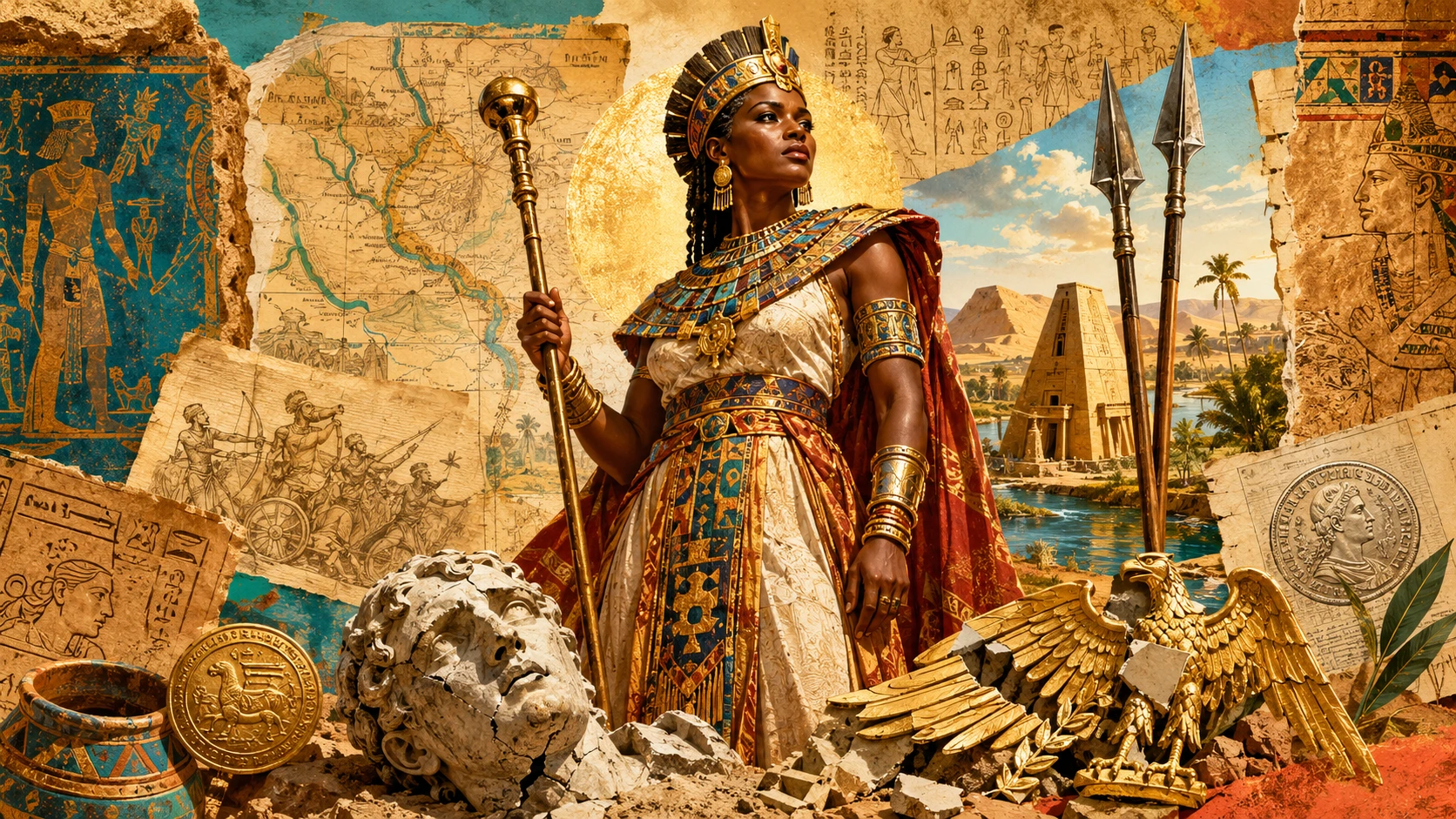
Amanirenas of Kush: The Queen Who Defied Rome
In the late first century BCE, the Kingdom of Kush faced one of the most powerful empires in the world. Rome had taken control of Egypt, and its southern frontier now pressed against Nubia.
The Kushite queen Amanirenas, often described as a kandake or ruling queen, led resistance against Roman expansion. She ruled from the kingdom centered around Meroe, in what is now Sudan. Her world was not a minor borderland. Kush had cities, temples, trade networks, armies, and a long royal tradition.
Ancient sources are limited and Roman-centered, so details are not always clear. But the broad outline is powerful. Kushite forces attacked Roman-held territory in Egypt. They captured towns and reportedly took statues, including images of Augustus.
Rome responded with military force. Yet the conflict did not end with Kush being absorbed. A settlement followed, and Kush kept its independence. This was no small achievement.
Amanirenas is often remembered for her military leadership, but her success was also political. Facing Rome required more than courage. It required timing, organization, and the ability to negotiate after violence.
Her story is rarely given the same attention as Cleopatra’s. Yet both women ruled in the shadow of Roman power. Cleopatra’s kingdom fell. Amanirenas’ kingdom endured.
Wu Zetian: The Emperor History Tried to Contain
Wu Zetian is not exactly unknown, but she is often treated more as a scandal than as a serious ruler. She began as a concubine in the Tang dynasty court and rose through one of the most competitive political worlds in history. In 690 CE, she declared herself emperor and founded the Zhou dynasty, interrupting Tang rule.
Her rise shocked later Confucian historians. A woman ruling as emperor challenged political and moral expectations. Because of that, accounts of her life are filled with accusations about manipulation, cruelty, sexual impropriety, and family betrayal.
Some of those accusations may contain truth. Court politics could be deadly. Wu was certainly ruthless at times. But male rulers who used similar tactics were often judged through a different lens.
Wu Zetian also governed with intelligence. She expanded the civil service examination system, promoted officials outside the narrowest aristocratic circles, supported Buddhism, and strengthened central authority. Her reign was not merely a court drama. It was a serious period of statecraft.
Her use of Buddhism was especially important. Buddhist ideas and institutions helped support her claim to rule. Religious symbolism gave her authority in a culture where older political traditions resisted female sovereignty.
Wu Zetian’s legacy remains complicated, as any imperial legacy should be. But the old habit of treating her mainly as a dangerous woman misses the scale of her achievement.
She did not just survive the Tang court. She took control of the empire.
Shajar al-Durr: The Sultan Who Stood Between Dynasties
Shajar al-Durr rose to power in 13th-century Egypt during a time of war and dynastic crisis. She had been the wife of the Ayyubid sultan al-Salih Ayyub. When he died during the Seventh Crusade, Egypt was in danger.
The crusading army led by King Louis IX of France had invaded Egypt. Revealing the sultan’s death too soon could have caused panic. Shajar al-Durr helped conceal it long enough to maintain command and manage the transition of power.
After the defeat and capture of Louis IX, she emerged as a central political figure. For a short time, she ruled as sultan in her own name. Coins were struck and prayers were reportedly issued in her authority, two major signs of sovereignty in the Islamic world.
Her rule faced opposition. A female sultan was unacceptable to many political and religious authorities. She married the Mamluk commander Aybak, but power between them remained tense. Her life ended violently after court conflict and betrayal.
Shajar al-Durr’s reign was brief, but its importance was great. She stood at the turning point between Ayyubid rule and the rise of the Mamluk Sultanate. The Mamluks would go on to rule Egypt and Syria for centuries.
Her story shows that short reigns can still alter history. She protected the state during invasion, helped defeat a crusade, and stood at the birth of a new ruling order.
Tamar of Georgia: The King Who Was a Queen
Tamar of Georgia ruled from 1184 to 1213, during a period often remembered as the Georgian Golden Age. She is sometimes called Queen Tamar in English, but Georgian sources used the title “king” for her. The title was meant to express full sovereign power, not merely royal femininity.
Her early reign was not easy. Powerful nobles challenged her authority. Some expected a young woman to be easier to control. Tamar had to negotiate, remove opponents, and build a stable base of support.
Once secure, she presided over a period of political strength, cultural growth, and military success. Georgian influence expanded across parts of the Caucasus. Literature, architecture, and religious life flourished.
Her reign is especially associated with the great Georgian epic The Knight in the Panther’s Skin, written by Shota Rustaveli. The poem reflects a court culture of refinement, chivalric ideals, and literary ambition.
Tamar was later remembered with deep reverence. The Georgian Orthodox Church canonized her. Yet outside Georgia, she remains far less known than many European monarchs whose achievements were no greater.
Her life complicates assumptions about medieval queenship. She was not merely a wife, mother, or temporary caretaker. She was the central sovereign of one of medieval Eurasia’s most dynamic kingdoms.
Razia Sultan: The Woman Who Took the Throne of Delhi
Razia Sultan ruled the Delhi Sultanate from 1236 to 1240. She was the daughter of Sultan Iltutmish, who reportedly saw more ability in her than in his sons. After his death, political conflict opened a path for Razia to take power.
Her rule challenged powerful expectations. She appeared in public authority, led armies, and used the title sultan rather than sultana. In that context, “sultana” could imply the wife or consort of a sultan. Razia claimed rulership itself.
She faced resistance from Turkish nobles who disliked being ruled by a woman. Her efforts to build alliances beyond the old elite also created enemies. One of the most controversial figures around her was Jamal al-Din Yaqut, an Abyssinian official whose rise angered aristocratic factions.
Razia’s reign was short. She was overthrown and killed after rebellion and military defeat. Later accounts often focused on gender, court intrigue, and personal scandal.
Yet her political significance remains clear. She was one of the few women to rule a major Islamic kingdom in her own name during the medieval period. She did so in a military environment dominated by powerful male nobles.
Razia’s story is not only tragic. It is also evidence of ability recognized, authority claimed, and resistance faced by a woman who refused a secondary role.
Margaret I of Denmark: The Architect of a Northern Union
Margaret I of Denmark is one of medieval Europe’s most important political figures, though she is not as widely known as she should be. Born into the Danish royal house in the 14th century, she became queen consort of Norway and later a ruler in her own right through regency, inheritance, and political skill.
Her greatest achievement was the creation of the Kalmar Union in 1397. This united Denmark, Norway, and Sweden under a single monarch, though the union was often tense and uneven.
Margaret did not rule simply by force. She used dynastic claims, diplomacy, noble alliances, legal language, and careful political management. She understood how to turn family connections into state power.
Her authority was unusual. She was not always crowned in the straightforward way a male king might have been. Instead, she ruled through titles such as “Lady and Master,” and through her position as guardian of royal succession. Yet in practice, she was the dominant political force in Scandinavia.
Margaret’s achievement was not permanent harmony. The Kalmar Union later faced conflict and eventually broke apart. Still, she reshaped northern European politics for more than a century.
She deserves to be remembered not as a queen in the margins, but as one of the great state-builders of medieval Europe.
Nzinga of Ndongo and Matamba: Diplomacy, War, and Survival
Queen Nzinga, also spelled Njinga or Nzinga Mbande, ruled in 17th-century Central Africa. She became a leading figure in resistance against Portuguese expansion and the Atlantic slave trade in the region of present-day Angola.
Nzinga was born into the royal family of Ndongo. She first became famous as a diplomat. In one well-known story, during negotiations with the Portuguese, she refused to accept a lower position when no chair was offered to her. An attendant knelt so she could sit at equal height with the Portuguese governor.
The story may have been shaped by later retellings, but it captures something true about her political style. Nzinga understood symbolism. She knew that ceremony could express power as clearly as weapons.
After political struggles and war, she ruled Matamba and continued resisting Portuguese influence. She formed alliances, used diplomacy, commanded forces, and navigated a brutal world shaped by slavery, trade, Christianity, African statecraft, and European imperial pressure.
Her legacy is complex. Like many rulers, she made hard alliances and operated within violent systems. But she also became a symbol of resistance and sovereignty.
Nzinga’s life shows a ruler adapting to catastrophe without surrendering political imagination. She remains one of Africa’s most remarkable leaders, and her fame outside the continent is still smaller than it should be.
Ahilyabai Holkar: The Philosopher Queen of Malwa
Ahilyabai Holkar ruled Malwa in central India during the 18th century. She came to power after the deaths of her husband and father-in-law, and after great personal loss. In many royal households, such losses could have ended a woman’s political life. In her case, they opened a path to rule.
She governed from Maheshwar and became known for justice, administration, public works, and religious patronage. Her reign was remembered as stable and relatively peaceful in a century often marked by warfare and shifting alliances.
Ahilyabai supported the building and restoration of temples, wells, ghats, roads, and rest houses across India. Her patronage reached far beyond her own capital. It connected sacred geography with royal duty.
She was admired not only for piety but for governance. Accounts emphasize her accessibility, discipline, and concern for ordinary people. As with any ruler, later memory may polish the image. Yet her reputation for capable administration is strong and lasting.
Ahilyabai’s power was not theatrical in the way some rulers’ power was. She did not build her legacy mainly through conquest. She built it through repair, order, patronage, and public trust.
That may be one reason she is not as famous globally. History often remembers battlefield rulers more easily than administrators. Yet societies are shaped just as deeply by those who govern well.
Why These Women Were Forgotten
These rulers were forgotten, minimized, or distorted for different reasons. Some came from regions that Western historical education has long neglected. Some ruled through roles that did not fit later ideas of monarchy. Some were judged by hostile chroniclers. Some were remembered locally but ignored internationally.
Gender mattered in nearly every case. Women in power often had to justify authority more carefully than men. Their bodies, marriages, children, lovers, and manners were treated as political evidence. A male ruler’s violence could be called strength. A woman’s violence could be called proof that female rule was unnatural.
Yet none of these women were symbols only. They were rulers. They made decisions under pressure. They commanded soldiers, negotiated treaties, controlled courts, managed succession, used religion, raised revenue, built alliances, and defended states.
Their stories also challenge a common mistake. People often imagine women’s history as separate from “real” political history. These lives show the opposite. Women were present at the center of war, empire, diplomacy, law, and state formation.
Remembering them does not mean pretending they were perfect. Some were ruthless. Some benefited from hierarchy. Some ruled over unequal societies. They should be studied with the same seriousness given to male rulers, not turned into saints or slogans.
The past becomes more accurate when these women return to view. It also becomes more interesting. Power was never as male, simple, or predictable as later memory made it seem.
A queen on a battlefield, a regent holding a kingdom together, a sultan ruling through crisis, a mother building an empire, a widow governing with discipline, these were not exceptions to history. They were part of it all along.
Style and structure followed the uploaded article brief.