Times in History When People Panicked Over Nothing
People rarely panic over absolutely nothing. Fear usually begins with something real, or at least something that feels real. A rumor. A sound. A disease. A new invention. A strange dance. A market craze. A newspaper headline. A change in daily life that people do not yet know how to understand.
What makes some historical panics so strange is the gap between the fear and the danger. A community reacts as if disaster has arrived, but later evidence shows that the threat was exaggerated, misunderstood, or almost entirely imagined.
These episodes can seem funny from a distance. Some are absurd. Others are darker. A panic can ruin reputations, waste money, spread cruelty, or lead authorities to punish innocent people. Fear may begin in confusion, but it does not always stay harmless.
The history of public panic is really a history of uncertainty. People overreact when they do not know whom to trust, what to believe, or what is changing around them.
The War of the Worlds Panic That Was Smaller Than the Legend
On October 30, 1938, Orson Welles and the Mercury Theatre broadcast a radio adaptation of The War of the Worlds. The program presented parts of H. G. Wells’s alien-invasion story in the style of breaking news reports. Some listeners believed, briefly, that something terrible was happening.
The famous version says that America fell into mass hysteria. People supposedly fled homes, crowded churches, called police, and prepared for the end of the world. The story became one of the most famous examples of media panic in modern history.
The real panic was much smaller. The National Endowment for the Humanities notes that scholars now view the “famous panic” as greatly exaggerated, though some people really were frightened. Some listeners had tuned in late and missed the opening notice that the program was fiction. (NEH)
The legend grew partly because newspapers had an interest in making radio look irresponsible. Radio was taking advertising money and attention away from print. A story about reckless broadcasting was useful to newspapers.
This does not mean no one panicked. Some did. The fear was real for those people. But the later myth turned scattered confusion into national collapse.
The episode shows how panic can happen twice. First comes the original fear. Then comes the panic about the panic, spread by people who benefit from retelling it.
Tulip Mania and the Myth of a Whole Country Gone Mad
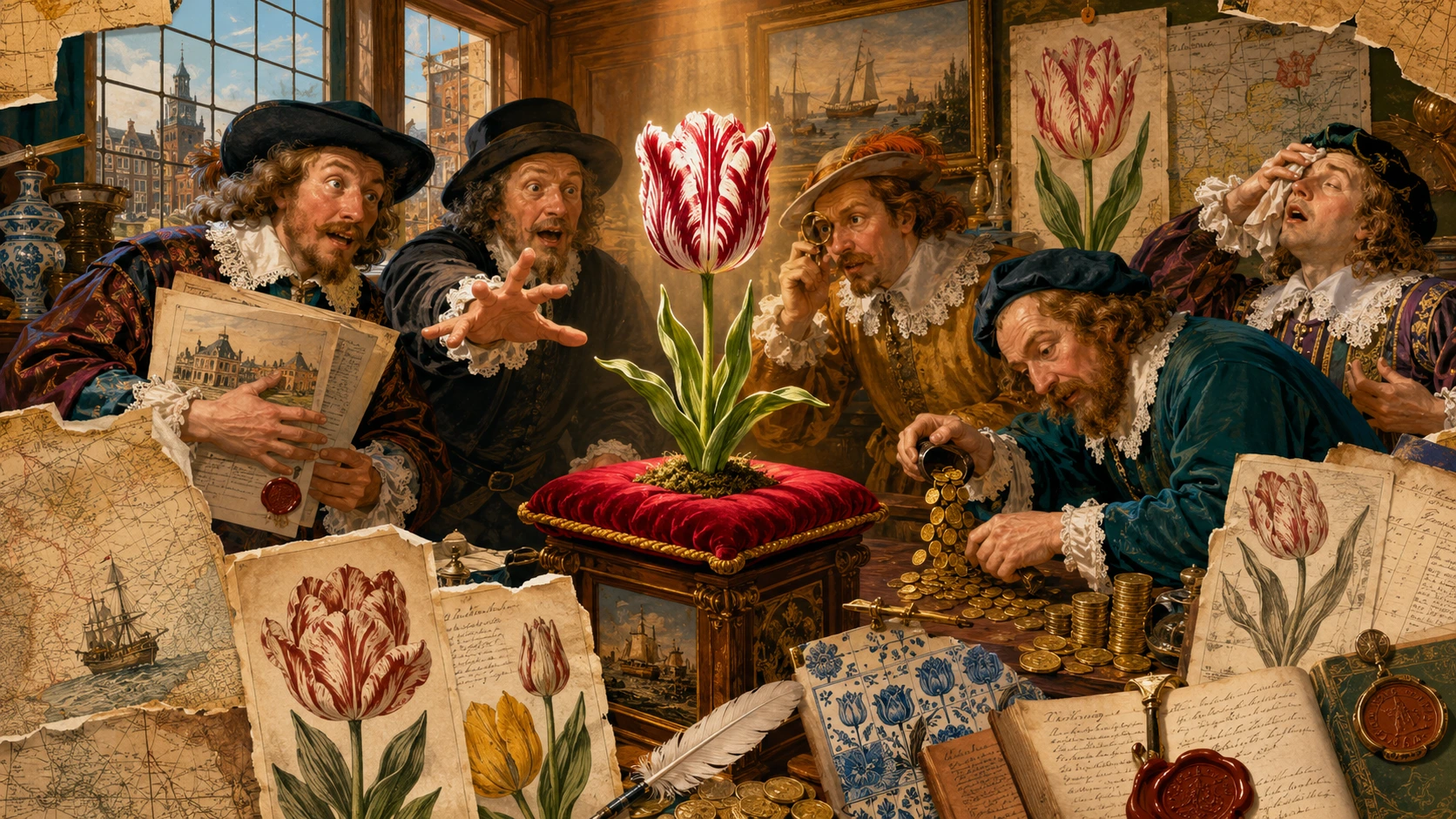
Tulip mania is often described as one of history’s wildest financial panics. The usual story says that Dutch society lost its mind in the 1630s. Ordinary people supposedly sold houses, farms, and livelihoods to buy tulip bulbs, only to be ruined when prices collapsed.
There was a real tulip bubble. Prices for some rare bulbs rose sharply and then fell in 1637. But the popular version is heavily exaggerated.
Smithsonian Magazine explains that the familiar story comes largely from later accounts, especially Charles Mackay’s 1841 book Extraordinary Popular Delusions and the Madness of Crowds. Mackay described a society-wide craze, but modern historians have found that the tulip trade involved a narrower group than his dramatic version suggests. (Smithsonian Magazine)
The panic was not imaginary, but it was not the total national madness people often imagine. It was a speculative market in luxury goods. It hurt some people, embarrassed others, and became a moral lesson.
The myth survived because it is useful. It gives financial greed a simple symbol. A tulip bulb becomes a warning about foolish desire.
The real history is more subtle. Dutch society did not collapse because of flowers. But later generations loved the story because it made economic irrationality easy to picture.
The Dancing Plague of 1518
In Strasbourg in 1518, a woman began dancing in the street. Others joined her. The episode grew into one of the strangest outbreaks in European history, remembered as the dancing plague.
Modern readers often imagine a city suddenly possessed by madness for no reason. The real situation was more complicated. People at the time lived with famine, disease, religious fear, and deep social stress. They also believed in spiritual forces that could punish communities.
Historians still debate what happened. History.com notes that scholars are not certain what caused the outbreak, though theories include mass psychogenic illness, religious anxiety, and physical stress. (History)
The panic came not only from the dancing itself, but from how people interpreted it. Authorities reportedly tried to manage the crisis in ways that now seem strange. In some accounts, they encouraged more dancing at first, believing the dancers needed to finish the illness through movement.
This was not “nothing” to those who lived through it. People were frightened. Some may have suffered or died. But the danger was not a curse in the way many believed.
The dancing plague shows how belief can shape illness. A body in distress may act through the cultural language available to it. In Strasbourg, that language included saints, curses, sin, and public fear.
Railway Madness and the Fear of Fast Travel
When railways spread in the 19th century, they changed time, distance, and daily life. Trains were loud, fast, crowded, and mechanically powerful. They moved people at speeds that earlier generations had rarely experienced.
Some Victorians feared that train travel could damage the mind. Newspapers and doctors discussed “railway madness,” a supposed condition in which passengers became suddenly violent, confused, or insane because of railway travel.
Atlas Obscura describes the Victorian belief that train travel could cause sudden insanity. Stories of “railway madmen” reflected fear of the sounds, motion, and social conditions of train journeys. (Atlas Obscura)
There were real train accidents. There was real anxiety about crowded compartments, strangers, and speed. But the idea that ordinary railway travel itself was producing waves of instant madness was an overreaction.
The panic makes sense when placed in context. Trains disrupted older ideas of space and safety. Passengers sat with strangers in enclosed compartments. The body moved faster than the mind was used to imagining. A machine could now hurl people across the landscape.
New technology often produces moral and medical fears before it becomes ordinary. What later generations call progress can first feel like danger.
The Bicycle Panic Over Women’s Bodies
In the late 19th century, bicycles became wildly popular. They offered speed, independence, and affordable movement. For many women, the bicycle was especially powerful. It allowed travel without a carriage, horse, or male escort.
That freedom made some people nervous. Critics warned that cycling could harm women’s bodies, damage morals, encourage improper clothing, or lead to sexual danger. Doctors and commentators worried about strain, posture, nerves, and reproductive health.
The bicycle did create real debates about clothing and safety. Long skirts could be dangerous near wheels and chains. Reformers promoted bloomers and other practical garments. But many warnings about female cycling were really warnings about female independence.
The panic was not just about a machine. It was about women moving through public space on their own.
The bicycle helped change fashion, courtship, exercise, and ideas of freedom. That is why it provoked such anxiety. A woman on a bicycle was not only riding. She was leaving behind older limits.
In this case, the panic was not over nothing in the minds of critics. They correctly sensed that something social was changing. They were wrong about the danger.
The Great Moon Hoax of 1835
In 1835, the New York Sun published a series of articles claiming that astronomer John Herschel had discovered life on the moon. The reports described lunar landscapes, strange animals, and even winged humanoid creatures.
The stories were false. They became known as the Great Moon Hoax. They were written in the style of scientific reporting, which helped make them believable to readers.
The panic here was not always terror. It was excitement, astonishment, and public credulity. People wanted to believe that science had opened a new world.
The hoax worked because astronomy was already changing how people imagined the universe. Telescopes had revealed wonders. Newspapers were expanding. Scientific authority carried power. The public was ready for marvels.
The moon creatures were invented, but the hunger for discovery was real. Readers were not stupid. They were living in a time when science had already made the impossible feel less impossible.
The Great Moon Hoax reminds us that not every panic is fear. Sometimes people panic toward wonder.
The Red Scare and Fear Hidden in Everyday Life
Some panics are not amusing at all. The Red Scares in the United States, especially after World War I and during the early Cold War, involved fear of communism, radical politics, spies, and subversion.
There were real communist movements. There were real spies. But the scale of suspicion often went far beyond the evidence. People lost jobs, reputations, and freedoms because accusation became powerful.
This kind of panic shows how a society can turn political fear into a search for enemies. The threat is no longer only outside the country. It is imagined inside schools, unions, churches, government offices, film studios, and neighborhoods.
The fear survived because it attached itself to uncertainty. Economic change, war, nuclear weapons, labor unrest, immigration, and global rivalry all made people anxious. Anti-communist panic gave that anxiety a target.
Calling it an overreaction does not mean the world was peaceful. It means fear often expanded beyond facts. People began to see plots where there were disagreements, and treason where there was dissent.
This is one of the darker lessons of moral panic. The imagined danger can become less harmful than the response to it.
Satanic Panic and Imagined Secret Rituals
In the 1980s and early 1990s, parts of the United States, Britain, and other countries were swept by fears of secret Satanic ritual abuse. Daycare workers, teachers, parents, and ordinary people were accused of belonging to hidden networks that supposedly abused children in elaborate ceremonies.
The claims were terrifying. They were also often unsupported by evidence. Investigations, trials, therapy practices, media coverage, and religious fear helped spread the panic.
Some people were convicted. Some later had convictions overturned. Families and communities were damaged. Children were sometimes questioned in ways that encouraged false memories or confused testimony.
The Satanic Panic did not come from nowhere. It grew from real concerns about child abuse, distrust of institutions, sensational media, religious anxiety, and changing family life. But those real concerns were channeled into a fantasy of organized occult conspiracy.
The panic shows how moral fear can use children as proof. Once people believe children are under hidden attack, doubt can look like cruelty. Skepticism becomes suspicious.
That is why moral panics are dangerous. They can make caution feel immoral.
The Clown Panic of 2016
In 2016, reports of creepy clowns spread across the United States and other countries. People claimed to see clowns near woods, schools, roads, and neighborhoods. Social media amplified the stories. Police departments received calls. Schools issued warnings. Some people were arrested for threats or hoaxes.
A few incidents were real. Many were rumors, jokes, copycats, or misunderstandings. The panic grew because it had the perfect modern ingredients: smartphones, local news, viral posts, childhood fear, and a familiar horror image.
Clowns had already become culturally unsettling through films, books, and urban legends. A strange figure standing near a road did not need to do much to trigger alarm. The costume itself carried menace.
The clown panic was not ancient or medieval. It was very modern. It showed that digital media can spread fear with the speed that older rumors never had.
The fear faded quickly. That is another feature of many panics. They feel overwhelming while they last, then suddenly look foolish when the attention moves on.
Why People Panic Over Almost Nothing
Historical panics rarely begin with pure emptiness. They begin with uncertainty. Something unfamiliar appears, and people rush to explain it.
A radio broadcast sounds like news. A flower market rises too fast. A new train feels unnatural. A bicycle gives women freedom. A child’s strange statement becomes evidence of conspiracy. A social media post turns a costume into a threat.
The reaction often reveals more than the trigger. Railway madness was about technology. Bicycle panic was about gender. Tulip mania myths were about greed. The Red Scare was about political insecurity. Satanic Panic was about family, religion, and trust. War of the Worlds panic was about media power and the fear of war.
People in the past were not uniquely gullible. Modern people react the same way. New technologies, diseases, rumors, crimes, and cultural changes still produce sudden waves of fear.
The difference is speed. A rumor that once moved through a town can now cross the world in minutes.
The strange panics of history remind us to ask better questions. Who benefits from the fear? What evidence exists? What older anxiety is being awakened? Is the danger real, or has the reaction become the danger?
A panic may begin with almost nothing. But once fear gathers a crowd, it can become something very real.
Style and structure followed the uploaded article brief.