
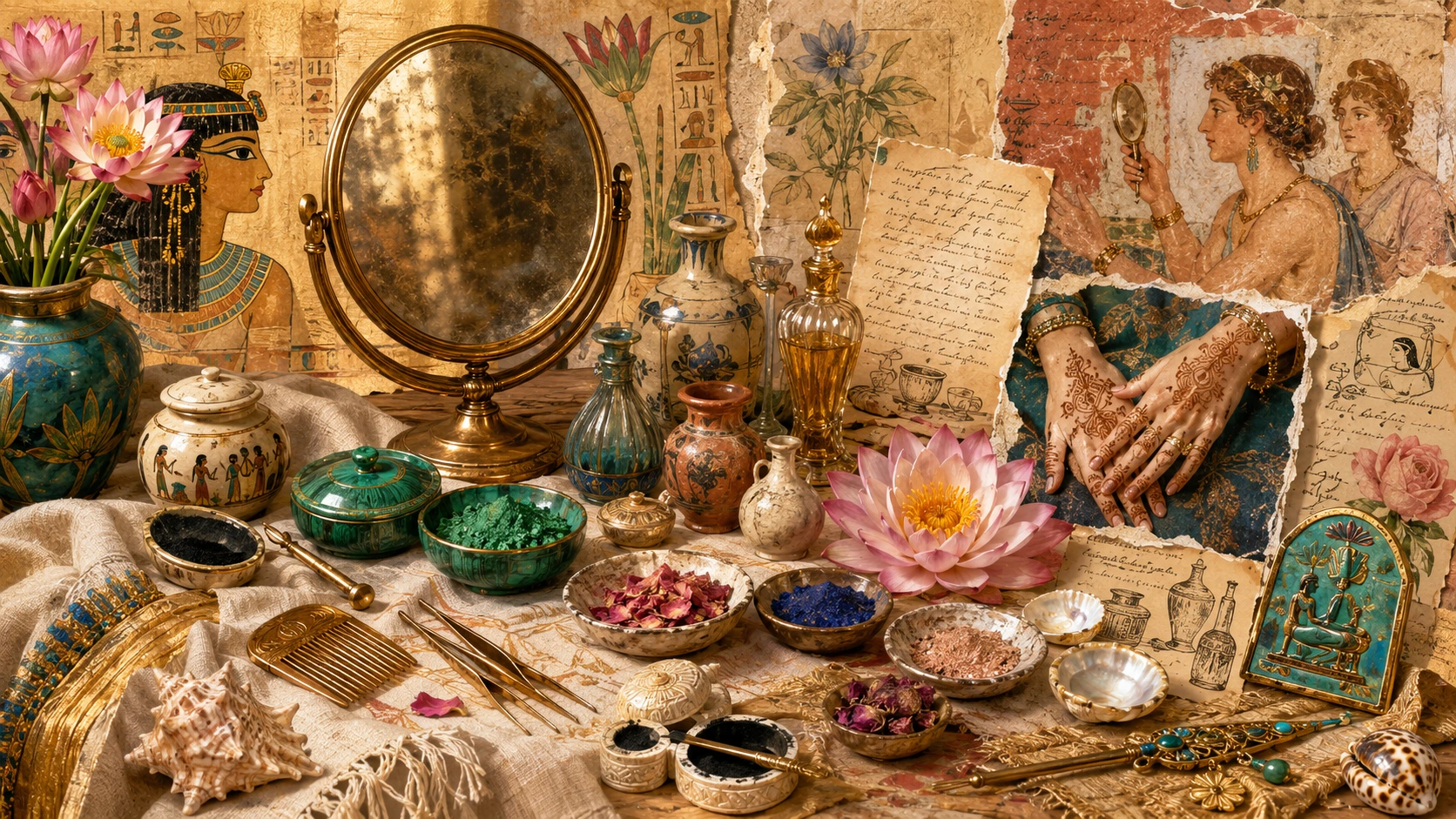
Ancient Beauty Secrets That Sound Strange Today
Beauty has always been more than decoration. In the ancient world, it could express health, status, religion, maturity, marriage, wealth, and moral character. A painted eye, scented oil, pale face, dark tooth, or carefully removed hair could say something important before a person spoke.
Some ancient beauty routines now sound strange, even shocking. People used lead-based eye paint. They rubbed oils and perfumes onto the body. They removed hair with scraping tools, resin, or pumice. They whitened skin with substances that could be harmful. They blackened teeth in cultures where dark smiles looked refined.
Yet these practices were not random. They belonged to worlds with different medicine, different materials, and different ideas of beauty. Some were dangerous. Some were practical. Some were both at once.
Egyptian Kohl: The Eye Makeup With a Medical Side
Ancient Egyptian eye makeup is one of the most famous beauty practices in history. Both men and women used dark eye paint. The black lines around the eyes are familiar from statues, coffin paintings, and modern images of ancient Egypt.
The main substance was kohl. It could include minerals such as galena, a lead sulfide ore, and other ingredients. A study of ancient Egyptian kohl containers found that recipes were more varied than earlier research suggested. Some included lead-based minerals, while others also contained manganese and silicon-based materials. (PMC)
To modern readers, the word “lead” immediately sounds alarming. That reaction is reasonable. Lead can be poisonous. But Egyptian kohl was not only about appearance. Researchers have argued that some lead compounds in Egyptian cosmetics may have helped stimulate immune responses around the eye. Chemistry World reported on research suggesting that lead-based cosmetics could have helped prevent eye infections. (Chemistry World)
This does not mean ancient Egyptian makeup was perfectly safe. It means the practice was more complicated than vanity. In a bright, dusty environment, eye paint may have been linked with health, glare protection, ritual meaning, and beauty all at once.
Kohl also had religious power. The eye was a symbol of protection in Egyptian culture. Darkened eyes could suggest order, care, and divine association. A cosmetic line was not just a cosmetic line.
Green Malachite and the Color of Protection
Before black kohl became the most iconic Egyptian eye cosmetic, green eye paint also had importance. Green pigment often came from malachite, a copper mineral. It was used in earlier periods and continued in some forms later.
Green carried symbolic meaning in Egypt. It could suggest growth, renewal, and life. This mattered in a culture where color had religious force.
Malachite eye paint now sounds unusual because modern beauty often separates cosmetics from ritual. In ancient Egypt, that line was thinner. A face could be beautified and protected at the same time.
The application process also mattered. Cosmetic containers, palettes, and applicators appear in tombs and archaeological contexts. Their presence shows that beauty routines belonged to daily life and the afterlife. A person might need cosmetics in both worlds.
The strangeness, then, is partly modern. Ancient Egyptians did not see makeup as a shallow extra. It could be medicine, magic, hygiene, identity, and art.
Roman Skin Whiteners and the Price of Pale Beauty
In ancient Rome, pale skin was often admired among elite women. It suggested that a woman did not labor outdoors. A pale face could signal leisure, wealth, and indoor life.
To achieve this look, Roman women used powders and creams. Some were relatively harmless, such as chalk or white marl. Others were dangerous. White lead was used as a skin whitener, despite ancient awareness that lead could be harmful. Accounts of Roman cosmetics describe white lead, chalk, marl, beeswax, oils, and many other substances used for the face. (Wikipedia)
This beauty ideal was tied to class. A darker complexion could suggest outdoor labor. A pale complexion could suggest privilege. The face became a social message.
Roman writers often criticized cosmetics. Male authors sometimes accused women of deception or moral weakness for using makeup. Yet the criticism itself proves the practice was visible and important.
The danger of white lead makes the routine seem shocking now. But Roman beauty culture rewarded the look strongly enough that some people accepted the risk. That pattern has not vanished from history. Many societies have praised appearances that carried real physical costs.
Crocodile Dung, Satire, and the Problem of Ancient Recipes
Some ancient beauty recipes sound almost unbelievable. Roman sources mention ingredients such as animal fats, ashes, wine dregs, and even crocodile dung. These details are often repeated because they are memorable.
They need careful handling. Ancient writers could be serious, but they could also mock, exaggerate, moralize, or repeat odd claims. Cosmetics were a favorite target for satire. A disgusting ingredient could make a woman’s beauty routine seem foolish or corrupt.
Still, some unpleasant ingredients really did appear in ancient medicine and cosmetics. The ancient world used materials from animals, minerals, plants, smoke, ash, oil, and bodily substances. The modern division between medicine, beauty, and superstition did not always apply.
For example, Roman rouge could be made from plant materials such as rose petals, poppy petals, mulberry juice, or red chalk. Other ingredients mentioned in ancient discussions sound much stranger. (Wikipedia)
The lesson is not that every shocking recipe should be believed at face value. It is that beauty history must read its sources carefully. Some ancient “secrets” were real practices. Others may have been insults dressed up as descriptions.
Perfumed Oils Before Modern Bath Products
Perfume was one of the great luxuries of the ancient world. In Egypt, Greece, Rome, Mesopotamia, and elsewhere, scent mattered deeply. It could mark status, cleanliness, seduction, religious ritual, and hospitality.
Ancient perfumes were not usually alcohol sprays like many modern perfumes. They were often oils or fats infused with aromatic substances. Ingredients could include myrrh, frankincense, cinnamon, iris, rose, lily, cardamom, and other costly materials.
Scent also had a practical role. In hot climates and crowded cities, pleasant fragrance mattered. Bathing, oiling, scraping, and perfuming could be part of bodily care.
In Rome, bathing culture made scented oils especially important. After washing, people might apply oil to the skin. The body could then be scraped with a strigil, a curved metal tool. The process removed oil, sweat, and dirt.
To modern readers, scraping the body clean may sound odd. But in a world without modern soap routines, it made sense. Oil loosened grime. The strigil removed it. Scent finished the process.
Beauty, health, and hygiene worked together.
Hair Removal With Pumice, Resin, and Tweezers
Ancient beauty routines often demanded smooth skin. In Rome, women removed body hair by shaving, plucking, scraping, or using resin-like pastes. Pumice stones could also be used. Roman sources and later scholarship describe hair removal as a common part of female grooming. (Wikipedia)
This was not only about comfort. Hair removal was tied to ideals of youth, femininity, refinement, and sexual attractiveness. A smooth body could signal care and status.
The work was often painful. Tweezing large areas took time. Resin could sting. Pumice could irritate the skin. Yet these routines persisted because beauty standards made them meaningful.
There was also a class dimension. A wealthy woman might have enslaved attendants or servants to help with grooming. Beauty could require labor from other people.
That is easy to miss when looking only at the final appearance. Ancient beauty was not just a face or body. It was a household system of time, tools, servants, materials, and money.
Blackened Teeth and the Beauty of Darkness
One of the most surprising beauty customs to modern eyes is tooth blackening. It appeared in several parts of Asia and Oceania. In Japan, the custom was known as ohaguro.
Ohaguro involved darkening the teeth with a solution often made from iron filings, vinegar, and tannin-rich materials. It was practiced in different ways across periods and social groups. It was especially associated with aristocratic culture, married women, and later other groups. It gradually declined during the Meiji period as Japan adopted new public ideals influenced by Western customs. (Wikipedia)
Modern readers often associate white teeth with health and beauty. In older Japan, black teeth could be seen as elegant, mature, and refined. Shiny black surfaces also had aesthetic value, much like lacquer.
The practice may also have helped protect teeth. The iron and tannin mixture could act like a coating. Some sources describe it as a sealant that helped prevent decay. (Wikipedia)
Tooth blackening is a powerful reminder that beauty standards are not universal. A smile that one culture finds attractive may seem strange to another. The body does not change much, but the meaning placed on it changes constantly.
Ancient Hair Dye and the Desire to Control Age
Hair color has long been connected to beauty, age, and status. Ancient people used many methods to darken, lighten, or alter hair. Some were plant-based. Others involved minerals, ashes, fats, or more unpleasant materials.
Roman sources mention recipes for changing hair color. Some were aimed at hiding gray hair. Others tried to create fashionable shades. Blonde hair could be admired, especially when associated with northern peoples or with certain ideals of beauty.
The desire to control age is not modern. Wrinkles, gray hair, blemishes, and uneven skin worried people long before modern cosmetics. Roman cosmetic culture included treatments for wrinkles, spots, and skin tone. (Wikipedia)
Some recipes were probably ineffective. Some were harmful. Some may have had modest practical effects. What matters is the desire behind them.
Ancient beauty was often an argument with time. People wanted the face to look younger, smoother, brighter, or more controlled. That impulse is still familiar.
The ingredients have changed. The anxiety has not.
Henna and the Beauty of Temporary Color
Henna has a long history as a dye for skin, hair, and nails. It has been used across North Africa, the Middle East, South Asia, and nearby regions. Unlike lead whitening or harsh depilation, henna is not strange because it is shocking. It is strange to some modern readers because it treats the skin as a temporary canvas.
Henna could mark celebration, fertility, marriage, protection, and beauty. Patterns on hands and feet could be social and symbolic. Hair dyed with henna could take on reddish tones.
This kind of beauty practice shows that not all ancient routines were dangerous or unpleasant. Some were artistic, communal, and seasonal. They linked the body to ritual time.
A modern person might think of makeup as something applied privately in a bathroom. Henna could be more social. It might involve women gathering, preparing, waiting, decorating, and celebrating together.
Beauty was not always a product. Sometimes it was an event.
Cosmetics for the Dead
One of the most striking ancient beauty habits is that grooming did not always end at death. In Egypt especially, the appearance of the dead mattered. Bodies were prepared, wrapped, adorned, and supplied with goods for the afterlife.
Cosmetic containers have been found in burial contexts. This suggests that makeup and grooming objects could be considered useful beyond ordinary life. The dead needed care, identity, and presentation.
This may sound strange today, but many modern cultures still groom the dead before burial. Clothing, hair, makeup, and personal objects remain part of mourning. The difference is in the religious and material details.
For Egyptians, bodily preservation and appearance were tied to afterlife beliefs. Beauty could be connected with rebirth, divine order, and eternal identity.
The ancient beauty routine was not only about being seen by the living. It could also prepare a person for the next world.
Why These Beauty Secrets Sound So Strange
Ancient beauty practices seem strange today because the materials are unfamiliar. Lead, malachite, animal fat, ash, pumice, resin, iron vinegar, and scented oils belong to a different world of chemistry and medicine.
They also seem strange because beauty ideals have changed. Modern culture often praises white teeth, natural-looking skin, smooth makeup, and sanitized products. Ancient cultures could admire black teeth, heavy eye paint, pale leaded skin, perfumed oil, or visible body modification.
But the deeper pattern is familiar. People wanted to look healthy, desirable, respectable, youthful, spiritual, powerful, or marriageable. They used the materials they had. They followed the standards around them. They accepted discomfort when beauty demanded it.
Some ancient routines deserve caution, not romance. Lead cosmetics could harm. Painful hair removal could injure the skin. Social pressure could force people into practices they might not have freely chosen.
Still, it is too simple to laugh at the past. Ancient beauty was not just superstition. It included observation, craft, chemistry, medicine, religion, and social meaning.
The most surprising beauty secrets from the past reveal how every age turns the body into a message. What changes is the language. One society writes beauty in kohl. Another writes it in perfume. Another writes it in pale powder, blackened teeth, smooth skin, or red hair dye.
The old routines may sound strange now, but the human wish behind them remains recognizable. People have always tried to make the body speak before words. Beauty has always been personal, but it has never been only private.
Style and structure followed the uploaded article brief.