
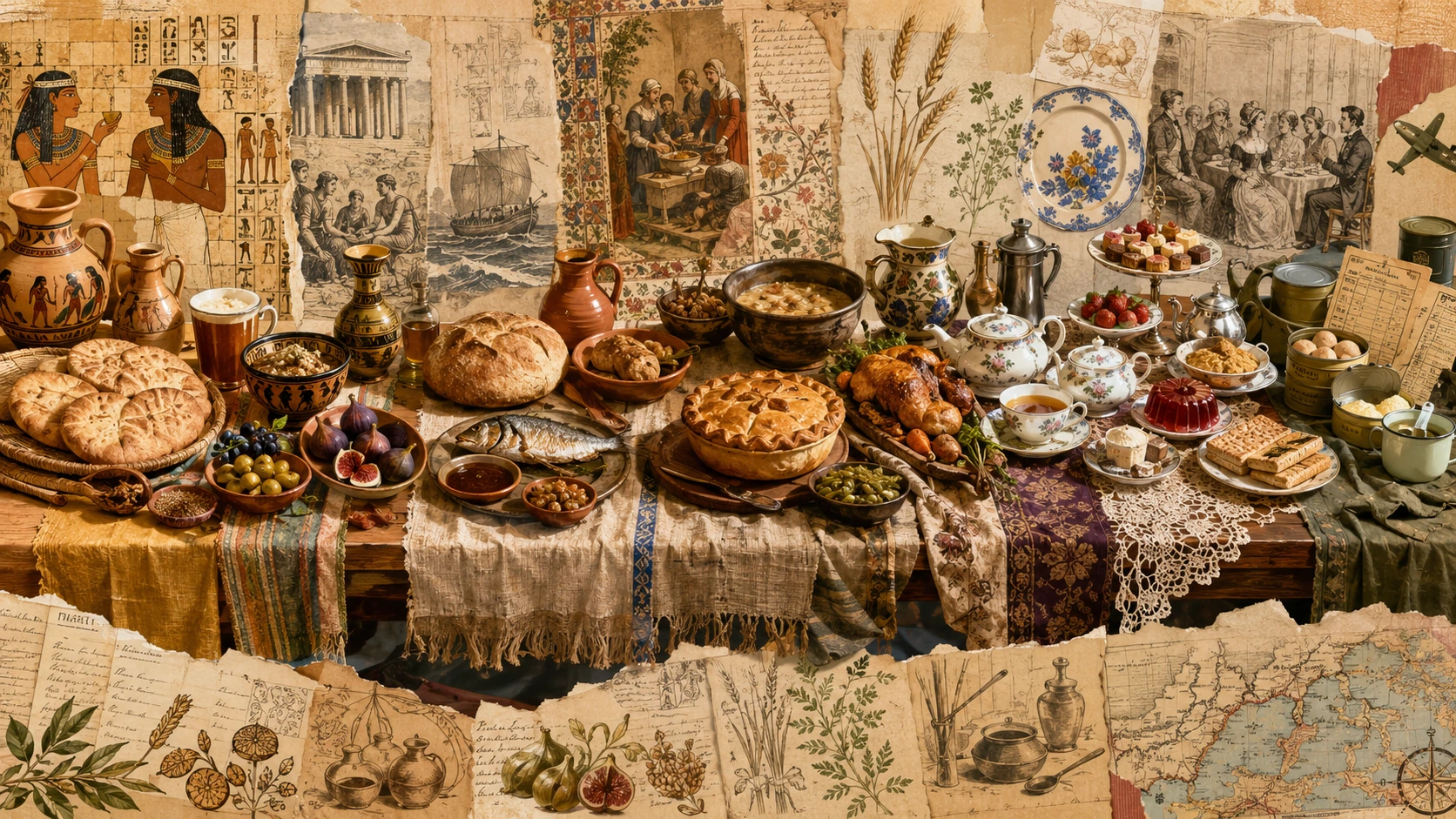
What People Ate During Famous Historical Eras
Food is one of the easiest ways to misunderstand the past. Paintings show banquets. Films show roasted meat, golden goblets, and crowded tables. Cookbooks preserve the dishes of the wealthy. Archaeology often finds what survived, not always what was ordinary.
Most people in history did not eat like kings, emperors, or courtiers. They ate what the land, season, money, religion, and local trade allowed. Their meals were often repetitive. Bread, grain, beans, onions, beer, porridge, oil, and simple stews mattered far more than rare delicacies.
Yet everyday food was never boring in the historical sense. It reveals labor, class, climate, belief, empire, and survival. What people ate tells us who had power, who worked the fields, who controlled trade, and who had to make a small amount of food last.
Ancient Egypt: Bread, Beer, and the Gift of the Nile
Ancient Egyptian food depended on the Nile. Its floods helped create fertile farmland in a dry landscape. Grain was central to life, and for many Egyptians, the basic diet rested on bread and beer.
The Metropolitan Museum of Art notes that bread and beer were staples of the Egyptian diet. Bread was often made from emmer wheat and baked in several forms, including flat loaves and long conical shapes. Food rations could even serve as payment for workers and household staff. (The Metropolitan Museum of Art)
Beer was not just a luxury drink. It was daily nourishment. It could be thick, cloudy, and filling. Workers, soldiers, and laborers might receive beer as part of their ration.
Ordinary people also ate onions, leeks, garlic, lentils, beans, cucumbers, lettuce, dates, figs, and other available produce. Meat existed, but it was not equally available to everyone. Wealthier households had better access to beef, fowl, fish, and more varied dishes.
Egyptian dining also had a religious dimension. Food offerings were placed in tombs and temples. The dead were imagined as needing sustenance in the afterlife. Food was not only practical. It connected the living, the gods, and the dead.
Ancient Greece: Bread, Olives, Wine, and Restraint
Ancient Greek meals were often simpler than modern Mediterranean restaurant food might suggest. The basic diet was shaped by grain, olives, and grapes. These provided bread, olive oil, and wine.
The so-called Mediterranean triad mattered deeply. Cereals, olives, and grapes were central to Greek agriculture and identity. Legumes were also important, especially for ordinary people who needed reliable protein. (Wikipedia)
Breakfast might be bread dipped in wine. Lunch could be light. Dinner was often the main meal. People ate barley cakes, wheat bread, lentils, beans, cheese, figs, olives, fish, and vegetables. Meat was less common for many households, although it appeared at sacrifices, festivals, and elite meals.
Wine was usually mixed with water. Drinking unmixed wine was often viewed as uncivilized in Greek culture. Food habits became a way to define Greek identity against outsiders. Bread, wine, and oil could mean more than nutrition. They could signal belonging. (Nunc est bibendum)
The famous symposium was not an ordinary family dinner. It was a male social gathering among elites. Guests drank, talked, listened to music, and performed wit. It belonged to a world of status, education, and male citizenship.
The daily diet of most Greeks was much humbler. A bowl of lentils or a piece of bread with olives tells us more about ordinary life than a painted cup full of party scenes.
Ancient Rome: Street Food, Garum, and Social Difference
Roman food was not one thing. The empire covered many regions and classes. A wealthy senator in Rome, a farmer in Gaul, a soldier near Hadrian’s Wall, and an enslaved worker near Pompeii did not eat the same way.
Still, some patterns are visible. Grain was vital. Bread, porridge, and later wheat-based distributions fed urban populations. Olive oil, wine, beans, lentils, vegetables, fruit, fish, and cheese were common parts of the diet.
Romans are famous for garum, a fermented fish sauce. It was used as a seasoning and traded widely. To modern readers, it may sound odd. In its own world, it added salt, depth, and flavor to many dishes.
Urban Romans also bought prepared food. Pompeii has preserved evidence of thermopolia, food stalls that sold hot meals. Researchers examining one Pompeian food stall found remains of duck, goat, pig, fish, and snails in containers. (KUOW)
This matters because not every Roman home had a convenient kitchen. Many urban poor lived in cramped buildings. Buying hot food was practical.
Elite Roman dining could be extravagant. Literary sources describe exotic dishes, elaborate service, and social competition. But those accounts do not represent everyone. They reveal the habits and anxieties of the wealthy.
Roman food also reminds us that class could produce strange contrasts. Recent Pompeii research suggests that some enslaved laborers on wealthy estates may have received nutritious food because owners wanted to preserve their workforce. That did not make slavery humane. It shows how food could be tied to exploitation as well as care. (Reuters)
Medieval Europe: Bread, Pottage, Ale, and the Church Calendar
Medieval food is often imagined as giant roasted meats and greasy feasts. Such meals existed among the rich, especially during celebrations. But the ordinary medieval diet was usually more repetitive.
Bread was essential. So was pottage, a thick stew made from grains, peas, beans, herbs, vegetables, and whatever else was available. Ale was common in many places because it was nourishing and safer than some water sources, though the quality and strength varied.
Historian Christopher Dyer has written that bread held deep importance in late medieval England. It was not simply one food among many. It carried social, nutritional, and symbolic weight. (Taylor & Francis Online)
Peasants ate according to the season. Spring could be difficult, when stored food ran low before new crops were ready. Autumn brought more abundance. Gardens supplied leeks, onions, cabbages, herbs, beans, and greens. Dairy, eggs, bacon, fish, or meat appeared when possible.
The church shaped the table. Many days restricted meat. Fish became important on fast days, though access depended on money and location. Wealthy households could turn religious restriction into variety, with elaborate fish dishes and imported ingredients.
Spices were prized among elites. Pepper, cinnamon, cloves, ginger, and saffron displayed wealth and trade connections. They were not used to hide rotten meat as often claimed. Freshness mattered then as now. Spices were expensive status goods.
Medieval dining was also social. People ate from trenchers, shared dishes, and followed rules of rank. Who sat where mattered. Who received which cut mattered. Food was a map of hierarchy.
Tudor England: Courtly Abundance and Plain Survival
The Tudor period is often remembered through royal feasts. Henry VIII’s kitchens at Hampton Court have helped fix that image in the public mind. At court, food was both nourishment and theater.
Historic Royal Palaces explains that Tudor court meals at Hampton Court were served in courses and in “messes,” portions shared between four people. Even lower servants at court could receive bread, ale, beef, veal, or mutton as part of their daily food. (Historic Royal Palaces)
This was not how everyone in Tudor England ate. Poorer households relied more heavily on bread, pottage, dairy, eggs, vegetables, and ale. Meat was desirable, but not always affordable in large amounts.
The Tudor table also reflected religious change. Fasting rules, fish days, and feast days were affected by the Reformation. What people ate could signal obedience, tradition, suspicion, or reform.
Sugar became more visible among the wealthy, though it remained expensive. Sweet and savory flavors were often mixed in ways that may surprise modern eaters. Meat pies, spiced sauces, dried fruit, and sweetened dishes appeared at elite tables.
Food also carried medical meaning. People believed diet affected the balance of the body. Hot, cold, moist, and dry qualities mattered in learned medicine. Eating was not just appetite. It was health management.
The Georgian and Regency Table: Display, Refinement, and New Habits
By the 18th and early 19th centuries, elite dining in Britain had become a performance of refinement. Meals could be elaborate, but manners mattered as much as food. A dining room displayed taste, rank, and social polish.
Imported goods shaped fashionable tables. Tea, coffee, chocolate, sugar, spices, citrus, wine, and colonial products became more common among those who could afford them. These pleasures were tied to empire, slavery, trade, and exploitation.
The famous Georgian dinner was not served like a modern plated restaurant meal. Many dishes could appear at once. Guests chose from what was near them, while servants and social rules managed the flow.
Jellies, creams, pies, roasts, fish, vegetables, puddings, pickles, sauces, and sweets all had their place. Cookery books became important guides for households that wanted to appear fashionable.
For ordinary people, the table was far less grand. Bread, potatoes, cheese, bacon, porridge, beer, tea, and seasonal foods played larger roles. In some regions, potatoes became increasingly important because they were filling and productive.
The era also changed the rhythm of drinking and sociability. Coffeehouses, tea tables, taverns, and assembly rooms helped create new public and semi-private food cultures. Eating and drinking became part of conversation, politics, gossip, and polite life.
Victorian Food: Industrial Cities and Respectable Dining
The Victorian era brought enormous change to food. Industrial cities grew. Railways moved fresh goods faster. Canning, refrigeration experiments, global trade, and mass production began reshaping what people could buy.
The rich still dined in style. Multi-course meals, printed menus, elaborate desserts, and strict etiquette became part of respectable upper and middle-class life. Dinner could be a ceremony.
But the Victorian poor often faced harsh food realities. Urban workers might depend on bread, tea, potatoes, dripping, cheap cuts of meat, porridge, or street food. Malnutrition was common in some communities. Food access depended on wages, rent, family size, and employment.
At the same time, public eating changed. The Victoria and Albert Museum describes its refreshment rooms as the world’s first museum café. In 1867, the menus were divided by social status, with first-class and second-class options. (Victoria and Albert Museum)
That detail captures the period well. Food was becoming more public and commercial, but class still structured everything. Even a museum café could mirror social hierarchy.
Victorian food also carried moral meaning. A clean table, regular meals, tea service, and proper manners could signal respectability. For middle-class households, dining was a way to prove order.
The age produced both abundance and hunger. It gave Britain tinned foods, railway milk, grand hotels, and decorated cakes. It also gave it slums where food was stretched painfully thin.
World War II: Rationing, Substitution, and Ingenuity
During World War II, food became a weapon, a duty, and a daily calculation. Rationing affected ordinary life in many countries. Governments needed to feed armies, manage shortages, control prices, and maintain morale.
In the United States, the government began rationing certain foods in 1942. Sugar came first. Coffee followed. Later came meats, fats, canned fish, cheese, and canned milk. The National WWII Museum notes that families received advice on stretching ration points and keeping meals varied. (The National WWII Museum)
In Britain, ration books became symbols of home-front life. Campaigns encouraged people to grow food, waste less, and adapt. The Museum of English Rural Life notes that rationing affected people of all ages and changed what they ate, how they traveled, and even how they dressed. (The Museum of English Rural Life)
Meals became practical. People used powdered eggs, margarine, root vegetables, canned goods, organ meats, and garden produce. Recipes taught cooks to replace scarce ingredients. Cakes might use less sugar. Meat might be stretched through pies, stews, or vegetable-heavy dishes.
Some wartime food now sounds grim. Yet rationing also created surprising nutritional patterns. In Britain, some poorer families gained steadier access to certain basic foods than before the war, though shortages and monotony were real.
The wartime table shows how food can become a shared civic system. A meal was not only private. It belonged to the war effort.
Why Historical Meals Matter
Food history is not just a record of strange dishes. It is a record of ordinary pressure. People ate according to land, labor, class, religion, technology, and power.
Ancient Egyptian bread and beer show the importance of grain and organized labor. Greek bread, olives, and wine show identity as well as diet. Roman street food shows urban life. Medieval pottage shows survival and season. Tudor court meals show hierarchy. Georgian tea and sugar show empire. Victorian dining shows class in an industrial world. Wartime rationing shows food as national discipline.
The odd foods are often memorable. Fermented fish sauce, thick beer, black broth, spiced meat pies, powdered eggs, and elaborate jellies catch the imagination. But the everyday foods matter more.
Most people in history did not eat to impress anyone. They ate to work, endure, celebrate, obey, recover, and belong. Their meals were shaped by what they could grow, buy, preserve, cook, and share.
The famous eras of history feel more human when seen through the table. A civilization is not only temples, battles, palaces, and laws. It is also bread cooling near a hearth, onions pulled from a garden, beer carried as wages, stew stretched for a family, tea poured carefully in a parlor, and a ration book opened before dinner.
Food makes the past intimate. It reminds us that every age had hunger, pleasure, habit, status, and taste. The dishes have changed, but the importance of the meal has not.
Style and structure followed the uploaded article brief.