
The Dark History Behind Everyday Objects
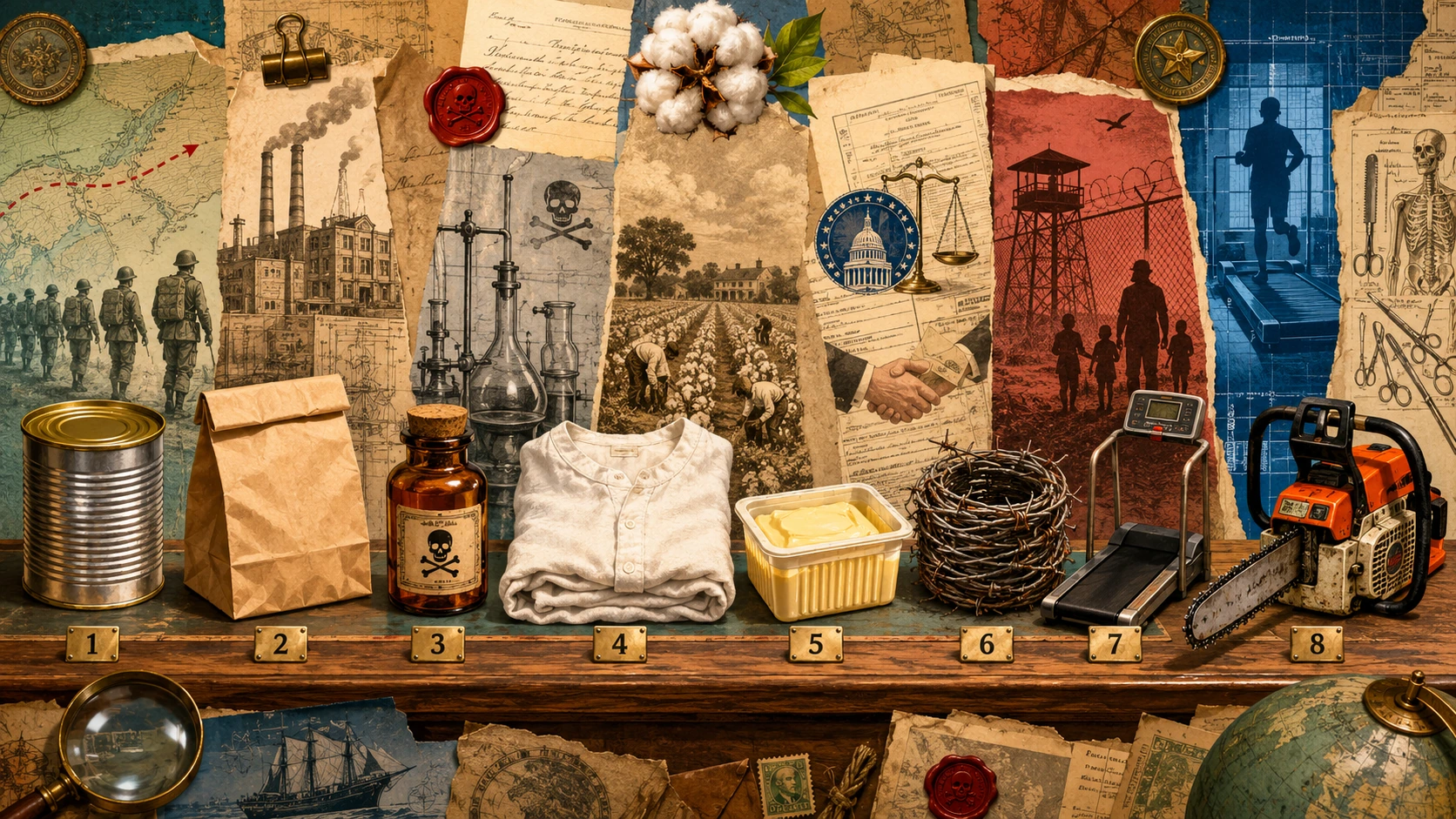
Ordinary objects often feel innocent because they have become familiar. A can of food, a treadmill, a paper bag, a fence, or a stick of margarine sits quietly inside daily life. It is easy to forget that many common things were shaped by war, punishment, inequality, exploitation, or social conflict.
This does not mean every everyday object is secretly evil. History is rarely that simple. Useful inventions often come from difficult worlds. They solve real problems, but the problems themselves may have been created by empire, prisons, poverty, slavery, or violence.
The dark history behind ordinary things is not always hidden because someone covered it up. Sometimes it is hidden by habit. Once an object becomes useful enough, people stop asking where it came from.
Canned Food and the Needs of War
Canned food now belongs to supermarkets, emergency shelves, camping trips, and quick dinners. Its origin, though, was tied closely to military need. In the early 19th century, France wanted better ways to preserve food for armies and navies. Nicolas Appert developed a method of sealing food in containers and heating it, winning a French government prize for food preservation. Britannica explains that canning grew from this search for a reliable way to supply military forces. (Encyclopedia Britannica)
The problem was simple and brutal. Armies moved. Food spoiled. Soldiers became sick. Supply lines could decide campaigns as surely as battles did.
Appert’s method did not begin with the modern tin can. He used sealed glass containers. Tin containers came soon after, making the process more durable and easier to transport. Over time, preserved food became part of civilian life.
The dark side is not that canned food was harmful. It saved lives and reduced spoilage. The darker point is that one of the most familiar kitchen conveniences was pushed forward by the demands of mass warfare.
A pantry staple began as part of the military problem of feeding men far from home.
The Treadmill Was Once a Prison Punishment
Today, the treadmill is a symbol of exercise, self-discipline, and health. It stands in gyms, bedrooms, hotels, and rehabilitation clinics. In the 19th century, it had a very different meaning.
The prison treadmill was introduced in England in 1818 as a form of hard labor. Prisoners climbed moving steps for hours. The machine could grind grain, pump water, or simply exhaust the body. Smithsonian Magazine notes that the first New York jail treadmill was installed in 1822, following the British model. (Smithsonian Magazine)
The punishment was designed to be repetitive and draining. It turned the body into a machine. That was the point.
Victorian penal reform often mixed discipline, labor, and moral correction. Prisoners were not only confined. They were made to perform work that authorities believed would punish and reform them. The treadmill fit that mindset perfectly.
Modern exercise treadmills are very different objects. They are voluntary, controlled, and connected to health. Still, the word carries an old shadow. A machine now used to improve fitness once helped enforce punishment.
The same motion that now suggests wellness once meant confinement.
Barbed Wire and the End of the Open Range
Barbed wire is so ordinary that it almost disappears into the landscape. It marks fields, borders, military sites, prisons, and private land. Yet its rise changed the American West in dramatic ways.
Earlier fencing was expensive on the Great Plains. Wood was scarce, stone was not always available, and smooth wire did not reliably stop cattle. Joseph Glidden’s successful barbed wire design of the 1870s helped make cheap fencing practical. Wired notes that Glidden’s 1874 design became the one that prevailed and spread widely. (WIRED)
The result was not just better fencing. It changed land itself. Open grazing became harder. Farmers and ranchers fought over access, movement, and ownership. Barbed wire helped carve the open range into controlled parcels.
For some settlers, it meant security. For others, it meant exclusion. For Indigenous peoples, open land had already been violently seized and transformed by colonization. Barbed wire became one more tool in the remaking of territory.
It later became associated with battlefields, camps, prisons, and borders. Its sharpness made it useful wherever people wanted to control bodies and movement.
A fence can look simple. Barbed wire shows that a fence can also be a political weapon.
The Cotton Gin and the Expansion of Slavery
The cotton gin is often taught as a clever invention that made cotton processing faster. That is true, but it is not the whole story. Eli Whitney’s cotton gin separated cotton fibers from seeds more efficiently. This made short-staple cotton far more profitable.
The result was catastrophic for enslaved people in the United States. National Geographic explains that the invention gave slavery “a new life” in the United States, helping expand slave-produced cotton from older plantation regions into lands farther west between 1800 and 1860. (National Geographic)
The machine did not reduce the demand for enslaved labor. It increased it. More cotton could be processed, so more cotton was planted. More land was taken. More enslaved people were forced into plantation labor.
This is one of the clearest examples of an invention producing consequences opposite to what a simple progress story might suggest. A machine that improved efficiency also strengthened a violent labor system.
Cotton remains an everyday material. It is in shirts, sheets, towels, and bags. Its long history includes comfort and commerce, but also forced labor and stolen lives.
An object can feel soft in the hand and still carry a hard history.
Margarine and the Politics of Cheap Food
Margarine now seems like an ordinary butter substitute. It sits in tubs, appears in baking recipes, and belongs to everyday grocery shopping. Its origin was tied to class, armies, and the search for cheaper food.
In 1869, French chemist Hippolyte Mège-Mouriès developed margarine after Napoleon III offered a prize for a cheap butter alternative. The substitute was meant for the armed forces and for people who could not afford butter easily. Britannica and other histories identify Mège-Mouriès as the inventor of this early butter substitute. (Wikipedia)
At first, margarine was not the plant-based spread many people know today. It was made from animal fats. Its appeal was economic. It offered something butter-like to people priced out of the real thing.
The darker history came later through food politics. In the United States, dairy interests fought margarine fiercely. Taxes, color restrictions, and sales rules tried to limit its spread. Serious Eats describes how some laws even required margarine to be dyed an unappetizing pink, making it harder to sell. (Serious Eats)
Margarine shows how food can become a battlefield. It was not only about taste. It was about class, industry, lobbying, law, and who controlled the table.
A spread on bread became part of a fight over money and power.
The Paper Bag and Forgotten Factory Labor
The paper bag looks plain. It carries groceries, lunches, books, medicine, and takeout. Its flat bottom seems so obvious that it is easy to forget someone had to invent a machine to make it practical.
Margaret E. Knight invented a machine that mechanized the production of flat-bottom paper bags. The Smithsonian American Women’s History Museum notes that these bags had previously been produced by hand, and that Knight’s invention helped transform retail commerce. (womenshistory.si.edu)
This history is not dark in the same way as slavery or prison labor. But it does reveal a quieter kind of erasure. Many everyday objects were shaped by workers and inventors whose names disappeared from public memory, especially women.
Knight’s work came from an industrial world where factories depended on repetitive manual labor. Mechanization could reduce handwork, but it also changed the relationship between workers, machines, and production.
The paper bag reminds us that convenience often hides labor. Someone folded the first versions by hand. Someone designed the machine. Someone fought to claim the invention.
The ordinary bag is also a record of industrial work that became invisible.
Chainsaws and Surgery Before Timber
The chainsaw is now associated with logging, landscaping, horror films, and heavy outdoor work. Its earliest form, however, did not begin in forests.
Late 18th-century Scottish doctors John Aitken and James Jeffray developed an early chainsaw-like surgical tool. It was used for procedures such as symphysiotomy and the removal of diseased bone. A Pharmacy Times history describes this early prototype as a medical device before chainsaws became tools of the timber industry. (Pharmacy Times)
The connection sounds shocking because modern chainsaws are loud, large, and violent-looking. The surgical version was smaller and hand-powered. Still, the history is unsettling.
Symphysiotomy involved cutting cartilage in the pelvis to widen the birth canal during difficult childbirth. It belonged to a world before modern cesarean surgery was safe and common. Doctors faced desperate cases with limited tools, limited anesthesia, and high maternal risk.
This does not make the invention monstrous by itself. It was created to solve medical problems. But it reflects how dangerous childbirth could be, and how invasive medical intervention could become.
The modern chainsaw’s origin is a reminder that medical history is not only healing. It is also pain, risk, experiment, and necessity.
The Birth Control Pill and Unethical Testing
The birth control pill is one of the most important everyday medicines of the modern age. It changed family planning, women’s lives, sexual culture, and medicine. Its history also includes serious ethical problems.
In the 1950s, early large-scale trials of the pill took place in Puerto Rico. PBS’s American Experience explains that Gregory Pincus saw Puerto Rico as a useful location because it had no anti-birth-control laws, had a network of birth-control clinics, and officials supported population control policies. (PBS)
Many women in the trials were not given the level of informed consent expected today. Side effects were not always treated with the seriousness they deserved. The testing took place in a colonial context shaped by poverty, population-control politics, and unequal medical power.
The pill brought real benefits to many women. It also arrived through research that used vulnerable women in ways that should not be ignored.
This is one of the hardest kinds of object history. A medicine can be liberating and still have an ethically troubling origin. Both truths can exist at once.
Progress is not made pure by its usefulness.
Why Everyday Objects Forget Their Origins
Objects lose their histories when they become useful enough. The can becomes dinner. The treadmill becomes exercise. The fence becomes background. The paper bag becomes trash. The pill becomes routine.
That forgetting is understandable. No one can think about the full history of every object every day. But looking back changes the way ordinary things appear.
These histories show that invention is not separate from society. Canned food was shaped by war. Treadmills were shaped by prisons. Barbed wire was shaped by land conflict. Cotton was shaped by slavery. Margarine was shaped by class and industry. Paper bags were shaped by factory labor. Chainsaws were shaped by dangerous surgery. The pill was shaped by medical ambition and unequal testing.
The point is not to reject every object with a troubling past. That would be impossible. The point is to see that daily life is built from older struggles.
Everyday objects are quiet survivors. They carry uses, improvements, and conveniences. They also carry the marks of the worlds that made them.
A thing can be practical and still have a shadow. History often lives that way, not in museums, but in the objects people touch without thinking.
Style and structure followed the uploaded article brief.