
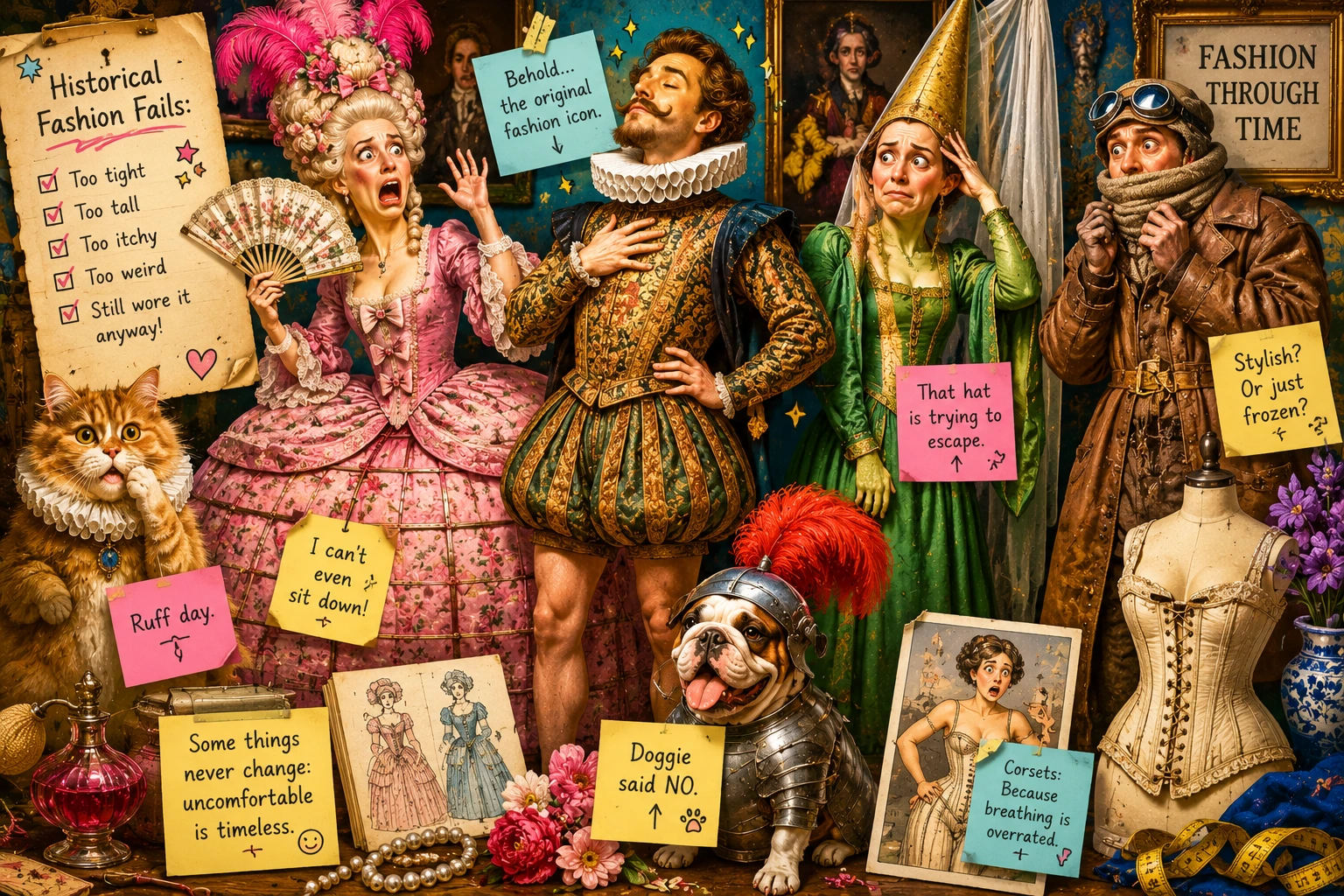
The Most Bizarre Fashion Trends in History
Fashion has never been only about looking good. It has also been about rank, wealth, religion, gender, politics, modesty, rebellion, and control. What people wore in the past often carried messages that were clear to their own society, even when they seem bizarre now.
Some historical fashions look strange because they were impractical. Others look strange because they reshaped the body. Some were painful. Some were dangerous. Some were expensive on purpose, because the whole point was to show that the wearer did not need to work like ordinary people.
The most unusual fashion trends in history are not just amusing details. They reveal what different societies admired, feared, and rewarded. A shoe, sleeve, collar, wig, or waistline could say far more than a modern reader might expect.
Venetian Chopines: Shoes That Turned Women Into Towers
In Renaissance Venice, some women wore platform shoes so high that walking became a public performance. These shoes were called chopines. They were fashionable from the late 15th century into the early 17th century, especially in Venice. The Victoria and Albert Museum describes them as both practical and symbolic. They raised the wearer above dirty streets, but they also displayed status. (Victoria and Albert Museum)
Some chopines were modest. Others were astonishingly tall. The highest examples could make movement difficult without assistance. A woman wearing them might need servants or companions to steady her.
That difficulty was part of the message. A person who could barely walk was not dressed for labor. The shoe announced privilege. It showed that the wearer belonged to a world where other people could help her move.
Chopines also changed the shape of clothing. Long skirts could fall over the platforms and create a taller, grander silhouette. The shoes were often hidden, but their effect was visible.
To modern eyes, they look like dangerous fashion. In their own world, they were a sign of elegance, rank, and display. They made the body taller, slower, and more theatrical.
Powdered Wigs and the Performance of Status
In 17th and 18th century Europe, wigs became central to elite male fashion. Large curled wigs appeared at courts, in portraits, and among wealthy professionals. They could be powdered white or gray, giving the wearer a formal and artificial appearance.
Wigs served several purposes. They covered hair loss. They helped create a polished public image. They also marked class and respectability. A large wig required money, upkeep, powder, and time.
The fashion was not only about vanity. It belonged to a society that valued visible rank. A judge, nobleman, courtier, or official dressed the part. Clothing created authority before a person even spoke.
Powdered wigs also remind us that cleanliness and grooming worked differently in the past. Hair washing was not as simple as it is now. A wig could be removed, cleaned, styled, and powdered separately.
The result seems strange today because it made the head look almost architectural. Yet in its own setting, a grand wig could make a man look serious, refined, and powerful.
The Macaroni Men of the 18th Century
In the late 18th century, a group of fashionable young British men became known as macaronis. Their style was extravagant. They wore elaborate clothing, tall hairstyles, bright colors, delicate accessories, and sometimes large decorative hats.
The name came from travel and taste. Young aristocratic men who had visited Europe returned with continental manners and fashions. “Macaroni” became a term for someone who carried refinement too far.
The Metropolitan Museum of Art notes that macaronis challenged ideas about fashion, gender, and taste in 18th-century Europe. Their grooming could be compared with elite women’s rituals, which made them targets of satire. (The Metropolitan Museum of Art)
Cartoonists mocked them as vain and affected. Their clothing seemed to blur masculine expectations. Their careful grooming made critics nervous because it suggested softness, foreignness, or moral weakness.
Yet the macaroni was not only a joke. He showed how fashion could become a battlefield over identity. What counted as masculine? What counted as elegant? What counted as too much?
The macaroni men were strange because they dressed as if life were a stage. In a sense, elite life often was.
Foot Binding and the Beauty of Pain
Some historical beauty practices cannot be treated as merely quirky. Chinese foot binding is one of them. For centuries, many girls had their feet tightly bound to alter their shape and size. The resulting feet were called lotus feet, and the tiny shoes made for them were lotus shoes.
Foot binding was most closely associated with Han Chinese women. It became a powerful marker of beauty, femininity, status, and marriageability. Its spread varied by period, class, and region, but by the late imperial era it had become deeply embedded in many communities.
The practice was painful and physically limiting. It reshaped the bones and restricted movement. Live Science describes lotus shoes as footwear made for women whose feet had been bound as children, with the custom lasting in some forms from roughly the Song dynasty period into the 20th century. (Live Science)
Foot binding reveals how beauty can become tied to social pressure. Families might bind a daughter’s feet not because they hated her, but because they feared her future without it. In some communities, unbound feet could reduce marriage prospects.
That does not make the practice less damaging. It shows how harm can survive when it is woven into status, family honor, and social expectation.
The fashion was not simply about small feet. It was about discipline, class, desire, control, and the shaping of women’s lives.
The Crinoline Cage
In the 19th century, fashionable skirts expanded dramatically. One of the most important tools behind this silhouette was the cage crinoline. It was a light framework worn under the skirt to hold the fabric outward.
Before the cage crinoline, women often needed layers of heavy petticoats to create volume. The cage could be lighter and more efficient. It allowed skirts to reach enormous widths without the same weight.
The Fashion History Timeline notes that the cage crinoline became one of the first mass-produced and widely adopted fashions. It was worn across different levels of society and helped create the ideal of a tiny waist beneath a wide skirt. (fashionhistory.fitnyc.edu)
The crinoline changed how women moved through space. A wide skirt could brush furniture, block doorways, and make crowded rooms difficult. It created distance around the body.
That distance could be socially useful. It gave the wearer presence. It also created a kind of protective barrier in public. At the same time, it made ordinary movement more complicated.
There were dangers too. Large skirts could catch fire near open flames. They could become trapped in machinery or carriage wheels. Fashion could be beautiful, but it was not always safe.
The crinoline was bizarre because it turned clothing into architecture. A woman did not simply wear a dress. She occupied a moving structure.
The Bustle and the Manufactured Silhouette
After the widest crinolines declined, another shape rose behind them. The bustle added volume at the back of a woman’s dress. It created a dramatic rear silhouette, especially in the late 19th century.
Bustles could be made from pads, springs, wire frames, horsehair, or other supports. Some were subtle. Others were large enough to look almost like furniture beneath the skirt.
The bustle reflected a major truth about fashion history. Beauty often meant reshaping the body into an approved outline. The natural body was not enough. It had to be arranged.
The Metropolitan Museum of Art explains that 19th-century fashion relied heavily on silhouette and support. Clothing worked with understructures to create changing ideals of the female form. (The Metropolitan Museum of Art)
Bustles now look odd because they exaggerate a part of the body in a highly artificial way. Yet they were not random. They followed a fashion system that valued novelty, display, and controlled shape.
Like the crinoline, the bustle turned the body into a designed object. It made fashion visible from across a room. It also proved that clothing could command attention through structure, not only color or fabric.
The Ruff: A Collar That Took Over the Neck
In 16th and early 17th century Europe, the ruff became one of the most recognizable fashion items among the wealthy. It was a stiff, pleated collar that framed the face. Some were small and neat. Others spread outward like wheels.
A large ruff required starch, careful laundering, and skilled setting. It could be expensive and uncomfortable. It limited head movement and made the wearer look formal, distant, and composed.
That was part of its power. A ruff forced posture. It lifted the head. It framed the face like a portrait. It made the wearer appear controlled and important.
The ruff also showed that the wearer had access to servants or specialists. Keeping such a garment clean and crisp was not easy. White linen near the face advertised both wealth and discipline.
The oddness of the ruff comes from its refusal to be casual. It did not help the body move. It made the body behave.
Blackened Teeth as Beauty
In some societies, blackened teeth were considered attractive. The practice is especially associated with Japan, where it was known as ohaguro. It also appeared in other parts of Asia in different forms.
To modern Western eyes, blackened teeth may seem like the opposite of beauty. But beauty standards are cultural. In some settings, darkened teeth suggested maturity, refinement, marital status, or elegance.
The practice could also have practical effects. Some mixtures used to blacken teeth may have helped protect against decay. But the meaning was not only dental. It was social.
Ohaguro was practiced by court women, married women, and others depending on period and status. Like many beauty customs, it changed over time. It was eventually discouraged and largely disappeared in modern Japan.
The practice is a useful reminder that beauty is not universal. A white smile is now marketed as natural and desirable in many places. In another time, a dark smile could suggest dignity and polish.
Beauty Patches and Artificial Flaws
In 17th and 18th century Europe, small decorative patches became fashionable. These were often made of black silk, velvet, or leather. They were placed on the face, neck, or chest.
Beauty patches could hide scars or blemishes. They could also draw attention to the skin. The contrast between a dark patch and a pale face was considered stylish.
Some patches were cut into shapes. Stars, moons, hearts, and other designs appeared. Their placement could carry flirtatious meaning, although later writers may have exaggerated the exact “language” of patches.
The fashion looks strange now because it turned an artificial mark into ornament. Modern cosmetics often try to conceal. Beauty patches announced themselves.
They also belonged to a world where small details mattered. A patch could suggest wit, sensuality, wealth, or courtly polish. It was tiny, but it was not meaningless.
Why Strange Fashion Felt Normal
The strangest fashions in history usually had logic behind them. Chopines made height and status visible. Wigs created authority. Macaroni clothing tested masculinity and taste. Foot binding reflected beauty tied to social control. Crinolines and bustles reshaped the body into fashionable outlines. Ruffs displayed discipline and rank.
These choices were not always comfortable. They were not always harmless. Some were merely inconvenient. Others caused real suffering.
Yet they all show that fashion is never just decoration. Clothing teaches people how to stand, walk, sit, gesture, and appear. It tells others what class someone belongs to, what gender role they are expected to perform, and what ideals they are willing to obey.
Modern fashion has its own strange rules. High heels, tight clothing, painful beauty routines, extreme dieting, cosmetic procedures, and status brands may look just as odd to future historians.
That is why old fashion should not only be laughed at. It should be read carefully. The body has always been a place where society writes its values.
The most bizarre fashion trends in history remind us that normal is temporary. A shoe can become a tower. A collar can become a frame. A skirt can become a cage. A painful body modification can become a standard of beauty. What seems absurd later may once have felt necessary, elegant, or respectable.
Fashion changes quickly, but the desire behind it is old. People have always used appearance to belong, impress, attract, obey, resist, and rise. The clothes may look strange now, but the human need beneath them is still familiar.
Style and structure followed the uploaded article brief.