
First Sleep and Second Sleep: The Forgotten Way People Used to Rest
For many people today, a good night’s sleep means one clean block of rest. You go to bed at night and wake in the morning. If you wake for an hour in the middle, it can feel like something has gone wrong.
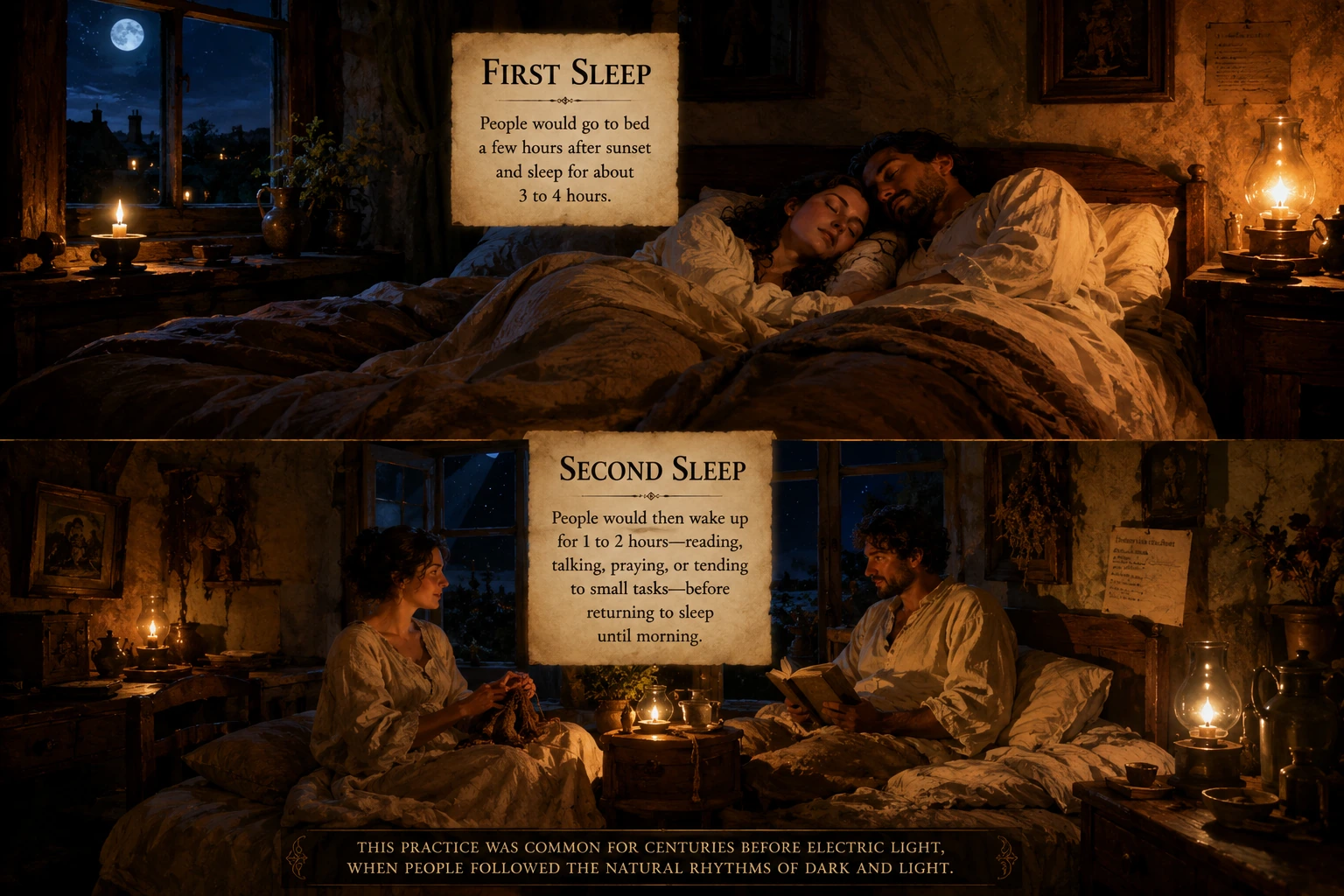
In parts of the preindustrial past, that middle waking period was not always treated as a problem. Historical records suggest that some people slept in two main stretches. The first was often called “first sleep.” The second was often called “second sleep” or “morning sleep.” Between them came a quiet interval of wakefulness.
This pattern is now called segmented sleep. It did not belong to every person, in every place, at every time. History is rarely that neat. But the evidence is strong enough to show that split sleep was familiar in many preindustrial European communities. Historian A. Roger Ekirch has found many references to first and second sleep in diaries, court records, medical texts, literature, and other sources. His work argues that segmented sleep was common in preindustrial Europe and not limited only to winter nights. (PMC)
The idea feels strange now because modern life has trained people to expect a single, uninterrupted night. Yet for earlier generations, night itself worked differently. It was longer, darker, quieter, and less controlled by clocks.
What “First Sleep” and “Second Sleep” Meant
First sleep usually began not long after nightfall. People went to bed earlier than many modern people do, especially in rural areas and in seasons with long nights. After several hours, they woke.
This waking period might last an hour or more. Then came the second sleep, which carried them toward morning.
The terms were ordinary enough to appear without much explanation. That is part of what makes the evidence interesting. When a phrase does not need to be explained, it often belongs to everyday life.
References to first sleep appear in different kinds of sources. Literary works mention it. Medical writers discuss it. Legal records sometimes refer to things that happened after a first sleep. These scattered traces suggest a habit that many readers or listeners would have recognized.
The pattern was not the same for everyone. A farmer, servant, monk, mother, traveler, merchant, and night watchman did not share one perfect schedule. Sleep was shaped by labor, season, age, household size, safety, illness, and poverty.
Still, the basic idea is clear. A broken night was not always seen as broken.
The Quiet Hours Between Sleeps
The waking interval between first and second sleep was not necessarily restless. People used it in different ways.
Some prayed. Some reflected on dreams. Some talked with a spouse. Some had sex. Some checked fires, tended animals, or did small household tasks. In crowded homes, this may have been one of the few private times of the night.
Ekirch’s research suggests that this interval was often treated as a calm and useful period. It was not simply insomnia in the modern sense. The wakefulness had a place inside the night. (PMC)
That distinction matters. Today, waking at 2 a.m. can feel alarming. A person may worry about work, health, productivity, or the number of hours left before the alarm. The anxiety itself can make sleep harder.
In a segmented sleep culture, the same waking might not carry the same fear. It could be expected. A person might lie quietly, say prayers, stir the fire, or speak softly in the dark.
The night was not empty. It had stages.
Why People Slept This Way
The simplest explanation is darkness. Before electric lighting, night lasted longer in daily life. Candles, oil lamps, rushlights, and hearths could provide light, but they cost money and effort. For many households, bright artificial evening light was limited.
When darkness came early, especially in winter, people often had more hours of night than they needed for one continuous sleep. Going to bed early could lead naturally to waking after several hours.
Yet darkness alone may not explain everything. Ekirch argues that segmented sleep appeared across seasons, not only in the long nights of winter. (PMC) The habit may have been supported by a wider rhythm of life.
Preindustrial time was different from modern time. Clocks existed, but many people did not live under the same strict schedules that later shaped factory and office life. Work could be demanding, but it often followed daylight, weather, animals, markets, bells, and household need.
Sleep also happened in less private spaces. Families, servants, apprentices, and travelers might sleep near one another. Beds could be shared. Homes were colder. Fires needed attention. Infants woke. Animals made noise. Streets outside could be unsafe.
A night of perfect silence was not the normal setting for many people. Waking did not always require explanation.
The Role of Dreams and Religion
The period between sleeps had a special connection to dreams. People often woke directly from first sleep and remembered what they had dreamed. In religious cultures, dreams could feel meaningful, troubling, or morally important.
Some people used the quiet interval for prayer. This made sense in a world where night carried spiritual weight. Darkness was linked with danger, temptation, fear, and mystery. It was also linked with reflection.
The midnight hours had long religious associations. Monastic life included night offices and prayer. Ordinary laypeople did not live like monks, but religious habits still shaped daily and nightly routines.
A person awake between sleeps might examine the soul, think about a dream, ask for protection, or prepare for the next day. This was not necessarily dramatic. It could be as ordinary as any repeated household habit.
Modern discussions sometimes romanticize this period as a lost spiritual treasure. That goes too far. Many people in the past were tired, cold, anxious, ill, or overworked. Their sleep was not automatically better than ours.
Still, the cultural meaning of night was different. The waking interval could be understood as part of rest, not only as the failure of rest.
The Bed Before Modern Comfort
Segmented sleep also belonged to a world of very different beds. Many people did not sleep on the kind of private mattress now considered normal. Bedding varied greatly by class and region.
The wealthy might have elaborate beds with curtains, mattresses, blankets, and servants to maintain them. Poorer people might sleep on straw, sacks, benches, simple pallets, or shared bedding. Travelers often slept in inns with strangers.
Beds were practical objects, but they were also social ones. A bed could be shared by spouses, children, siblings, servants, guests, or lodgers. Privacy was limited.
This affects how first and second sleep should be imagined. It was not always a peaceful scene of one person waking in a quiet room. It could happen in a crowded chamber. Someone shifted. A baby cried. A fire cracked. A dog barked. A neighbor passed outside.
The past was noisy in different ways. It lacked traffic and electronic hum, but it had animals, weather, voices, bells, wooden floors, and open hearths.
Sleep was woven into that world.
How Artificial Light Changed the Night
The decline of segmented sleep is often linked to artificial lighting. This change did not happen overnight. It unfolded over centuries.
Street lighting expanded in cities. Better candles became available to some households. Oil lamps improved. Gas lighting transformed urban evenings in the 18th and 19th centuries. Electric light later pushed the change much further.
Light changed more than visibility. It changed behavior. People could work later, read later, shop later, socialize later, and travel through cities with less fear. Night became more usable.
As evening activity expanded, bedtime moved later. A shorter night left less room for two long sleeps with a waking interval in between. Sleep became more compressed.
Industrial work also mattered. Factories, offices, schools, and transport systems rewarded punctuality. The modern schedule encouraged people to sleep in one block and wake at a set time.
Over time, uninterrupted sleep became the ideal. Waking at night turned from ordinary experience into a symptom. It could be treated as disorder, weakness, stress, or bad sleep hygiene.
That shift says as much about society as it does about biology. Modern sleep is shaped by lamps, clocks, wages, commutes, screens, and expectations.
Was Segmented Sleep Universal?
It is important not to turn first and second sleep into a new myth. The evidence does not prove that every preindustrial person slept this way every night. Nor does it prove that segmented sleep is the single “natural” human pattern.
Some modern research complicates the story. A 2015 study in Current Biology examined sleep among three nonindustrial societies and found that people there generally did not show the classic first-sleep and second-sleep pattern often described for preindustrial Europe. (Europe PMC)
Ekirch challenged the idea that this disproved historical segmented sleep. He argued that the European evidence remains strong and that sleep patterns vary by culture, ecology, season, and social setting. (PMC) More recent scholarship has continued to reconsider how far the segmented sleep model should be applied. A 2023 review notes that some claims about lost sleep patterns remain debated and need careful handling. (PMC)
The safest conclusion is also the most interesting one. Human sleep has not had one timeless form. It has changed with environment, labor, technology, and culture.
Some people slept in segments. Some did not. Some napped. Some slept lightly. Some rose for night work. Some were kept awake by hunger, danger, grief, cold, or children.
The past does not give us one perfect sleep schedule. It gives us variety.
Why the Idea Feels So Powerful Today
First sleep and second sleep became popular in modern discussion partly because many people now struggle with sleep. The idea offers comfort. Waking in the night may not always mean disaster.
That does not mean modern insomnia should be dismissed. Chronic sleeplessness can be serious. Pain, anxiety, illness, medication, stress, shift work, and sleep disorders all matter. Historical curiosity is not medical advice.
Still, the history can soften one fear. A period of wakefulness at night is not automatically unnatural. Humans have lived with many sleep rhythms.
The modern eight-hour block is not fake. Many people do well with it. But it is not the only pattern people have ever known.
This is why segmented sleep attracts attention. It challenges a rigid idea of normal. It suggests that some of our distress comes not only from waking, but from believing that waking should never happen.
The past does not solve the problem. It widens the frame.
The Night We Forgot
First sleep and second sleep reveal a forgotten relationship with darkness. Before modern lighting, night was not just a pause between days. It had its own structure. It shaped prayer, fear, intimacy, work, dreams, and rest.
People did not simply sleep worse because they lived before electricity. They slept differently. Their nights were longer in some ways and less controlled in others. They lived closer to darkness, but also closer to its rhythms.
The story of segmented sleep is not a call to abandon modern life. It is a reminder that habits we treat as natural may be historical. The way people sleep is shaped by more than the body. It is shaped by lamps, labor, money, architecture, family, religion, and time.
Somewhere between first sleep and second sleep, earlier generations found a quiet hour that modern life largely erased. It was not always peaceful. It was not always chosen. But it belonged to a different night than ours.
That lost interval reminds us that even sleep has a history. The most private part of life is still touched by the world around it.
Style and structure followed the uploaded article brief.