
The Most Unusual Punishments in History
Punishment has never been only about pain. It has also been about display, fear, shame, obedience, and power. In many societies, the point was not simply to correct the offender. It was to send a message to everyone watching.
Some punishments from history now seem bizarre. A person could be locked in a wooden frame in the marketplace. A woman accused of scolding could be ducked in water. A prisoner could be forced to climb a machine that went nowhere. A person could be silenced with an iron device placed around the head.
These punishments were unusual, but they were not random. They reveal how societies tried to control behavior before modern prisons became the usual answer. They also show how public humiliation, gender expectations, class hierarchy, and religious morality shaped ideas of justice.
The Pillory: Shame as Public Theater
The pillory was one of the most recognizable public punishments in Europe and colonial America. It usually consisted of a wooden frame raised in a public place. The offender’s head and hands were locked through holes, leaving the person exposed to the crowd. Britannica defines it as a wooden post and frame fixed on a raised platform, designed to hold the offender in public view. (Encyclopedia Britannica)
The pain of the position mattered, but humiliation mattered more. The pillory turned punishment into a public performance. People could stare, laugh, insult, throw objects, or simply remember the face of the offender.
The crimes punished this way varied. Fraud, perjury, libel, cheating, and other offenses could lead to exposure in the pillory. The punishment worked by attacking reputation. In a society where honor, credit, and public trust mattered deeply, shame could be devastating.
The pillory also gave the crowd a role. Justice was not hidden behind prison walls. It took place in streets, markets, and squares. The community became witness, judge, and sometimes tormentor.
That public role made the punishment unpredictable. Some offenders were mocked. Others gained sympathy. A crowd might punish more harshly than officials intended. In this way, the pillory shows both the power and danger of public justice.
The Stocks: Ordinary Discomfort Made Visible
The stocks were related to the pillory, but usually held the legs or feet. A person could be seated or bent into an uncomfortable position for hours. Like the pillory, the stocks placed the offender where others could see them.
The punishment seems mild compared with execution or mutilation. Yet that can be misleading. Sitting immobilized in public could be painful, degrading, and frightening. Weather, hunger, insults, and thrown refuse could make the experience worse.
The stocks were useful to authorities because they were simple. They did not require long imprisonment. They did not require a complex prison system. They made an example of someone quickly and cheaply.
They also punished small disorder. Drunkenness, minor theft, public nuisance, and market offenses could be handled through exposure. The goal was often correction through embarrassment.
The stocks remind us that premodern justice often dealt with ordinary life in ordinary places. Punishment did not always happen in a court building. It might stand near the market where everyone passed by.
Ducking Stools and the Punishment of “Scolds”
One of the strangest punishments in early modern England and elsewhere was the cucking or ducking stool. Britannica describes cucking and ducking stools as punishments involving humiliation, beating, or even death. The cucking stool placed the accused person in public view, while the ducking stool involved lowering the person into water. (Encyclopedia Britannica)
These punishments were often associated with women accused of being “scolds.” A scold was not simply someone who spoke loudly. The term was used for women seen as quarrelsome, disorderly, or disruptive to household and community peace.
This makes the punishment deeply revealing. It was not only about noise. It was about gender and control. A woman who argued too much, challenged authority, or disturbed neighbors could be treated as a public problem.
The ducking stool turned speech into spectacle. The accused person was displayed, restrained, and sometimes plunged into water before witnesses. The body was punished for a social offense tied to the tongue.
Modern readers may find the punishment absurd. But it shows a serious anxiety. Communities wanted order inside households, streets, and markets. Women’s speech, especially when angry or public, could be treated as a threat to that order.
The Scold’s Bridle: Silencing Made Physical
Even more disturbing was the scold’s bridle, sometimes called the brank. It was an iron device placed over the head. Some versions included a piece of metal that pressed down the tongue.
The National Trust for Scotland describes a scold’s bridle as an iron headpiece that opened on hinges and enclosed the head. In its basic form, it included a flat piece of iron projecting inward to hold the tongue still. (National Trust for Scotland)
This punishment made the symbolism brutally clear. A person accused of improper speech was literally silenced. The device turned social discipline into metal.
It was often used against women, though not only women. It punished scolding, gossip, slander, nagging, and other forms of speech judged disruptive. Its use reflects a world where speech was not equally free for everyone.
The bridle also carried animal imagery. To bridle someone was to control them like a horse. That meaning would not have been lost on people who saw it.
The punishment was not only painful and humiliating. It reduced a person’s voice to a public warning. It told others, especially women, that speech could be treated as disobedience.
The Treadwheel: Labor Without Escape
The modern treadmill belongs to gyms and fitness routines. Its ancestor was a prison punishment. In 1818, British engineer Sir William Cubitt introduced the treadwheel as a way to employ convicts through hard labor. Britannica describes it as a large cylinder with wooden steps, forcing prisoners to keep stepping as the wheel rotated. (Encyclopedia Britannica)
Sometimes the treadwheel powered useful work, such as grinding grain or pumping water. At other times, the labor was mainly punitive. OpenLearn notes that the power produced could be used in practical ways, but at worst it was simply wasted. (The Open University)
The punishment was unusual because it looked purposeful while often being meaningless. Prisoners climbed, but went nowhere. They worked, but not always for a useful result. Their exhaustion became the point.
The treadwheel belonged to a period when prison reformers and officials believed labor could discipline the body and soul. Idleness was seen as morally dangerous. Repetition, silence, and fatigue were supposed to produce order.
The machine also made punishment measurable. Officials could count hours, steps, and effort. The body became part of a system.
Today, the treadmill is voluntary. In its prison form, it was a machine of compulsion. That difference changes everything.
The Drunkard’s Cloak: Wearing Shame
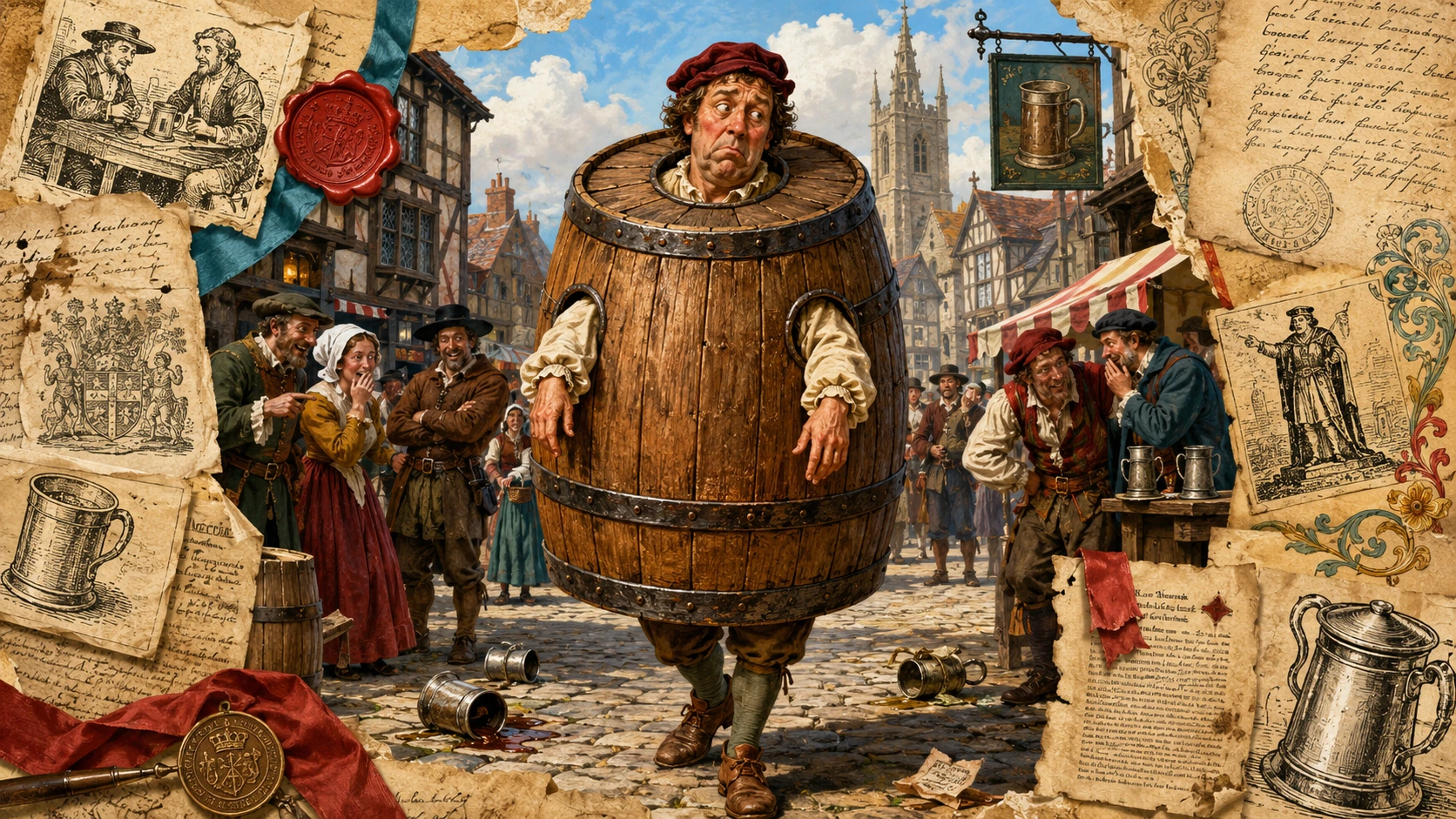
In parts of early modern Europe, one punishment for drunkenness was the drunkard’s cloak. The offender was forced to wear a barrel-like object, often with holes for the head and arms. They might then be paraded through town.
The punishment sounds comic, and that was part of its design. It turned the drunk person into a walking joke. The body became an advertisement for bad behavior.
Drunkenness was not treated only as a private weakness. It could be seen as a threat to work, household order, religion, and public peace. A drunk person might fight, waste wages, neglect duties, or disturb neighbors.
The drunkard’s cloak worked through ridicule. It made punishment memorable for both the offender and the crowd. It also allowed authorities to punish without long imprisonment.
This kind of public shaming was common in communities where reputation mattered. To be laughed at by neighbors could hurt more than a fine.
The cloak shows how punishment could become theater. It also shows how humor and cruelty often mixed in public discipline.
The Wooden Horse: Military Discipline Through Pain
The wooden horse was a military punishment used in some European armies and colonial settings. It was not a toy-like object. It was a narrow wooden structure, often with a sharp or uncomfortable edge, on which the punished person was forced to sit.
Sometimes weights were attached to the person’s legs to increase pain. The punishment could be used for soldiers who broke discipline.
Military punishment had its own logic. Armies depended on obedience, routine, and fear of disorder. A soldier who disobeyed did not only break a rule. He threatened the chain of command.
The wooden horse punished the body in a highly visible way. It made pain a lesson for the whole unit. The soldier’s suffering warned others not to test authority.
The punishment also reveals how harsh military life could be. Armies were not only dangerous because of battle. They could be brutal inside their own ranks.
Branding: Crime Written on the Body
Branding was used in many societies as a punishment or mark of status. A hot iron could burn a symbol, letter, or sign into the skin. The mark might identify a thief, deserter, enslaved person, or convicted criminal.
Branding was unusual because it lasted beyond the sentence. A fine ended when paid. A whipping ended when the blows stopped. A brand could remain for life.
The punishment turned the body into a legal record. It made the past visible. This could block future employment, marriage, trust, or movement.
Branding also helped authorities identify repeat offenders. In a world before photographs and digital records, a physical mark could serve as documentation.
The cruelty was not only in the pain. It was in the permanence. A person could be forced to carry public judgment on the skin.
Branding shows how law could try to make identity fixed. It reduced a person to an offense and made forgetting almost impossible.
The Mask of Shame
In early modern Europe, shame masks were sometimes used to punish behavior seen as foolish, immoral, or socially disruptive. These metal masks could be shaped with exaggerated features. Some had long noses, animal shapes, or ridiculous expressions.
The person wearing the mask might be paraded through public spaces. The punishment depended on ridicule. It made the offender into an object of laughter.
Like the scold’s bridle, shame masks often targeted social behavior rather than violent crime. Gossip, disorder, sexual misconduct, or breaches of public manners could become punishable through display.
The mask changed the face. That mattered. The face is where identity, dignity, and emotion are most visible. To cover it with a grotesque object was to strip away ordinary social respect.
This kind of punishment reveals how much premodern communities cared about conformity. The goal was not only to stop crime. It was to correct behavior that seemed to disturb the moral order.
Public Penance: Punishment for the Soul
Not every unusual punishment was designed by secular courts. Religious institutions also used public penance. A sinner might be required to stand before a congregation, wear special clothing, carry a candle, confess wrongdoing, or ask forgiveness.
The offense might involve adultery, fornication, heresy, blasphemy, or other religious and moral violations. The punishment aimed at correction, shame, and spiritual restoration.
To modern eyes, public confession can seem strange. Religion is often imagined as private. But in many historical communities, sin was public because it threatened the whole social body.
Public penance turned morality into a communal event. Everyone saw the offense acknowledged. Everyone saw the person humbled.
This could be sincere and meaningful. It could also be coercive and humiliating. The same ritual could offer reintegration while also enforcing control.
Public penance shows how closely law, religion, and reputation could be tied together. A person’s soul was not treated as entirely their own business.
Why So Many Punishments Were Public
The most unusual punishments in history often had one thing in common: witnesses. They were meant to be seen.
Before modern policing and large prison systems, visibility was useful. A punishment in the marketplace warned hundreds of people at once. It cost less than long confinement. It turned the crowd into part of the justice system.
Public punishment also reinforced hierarchy. It showed who had authority and who did not. Magistrates, clergy, rulers, officers, husbands, masters, and communities all used punishment to protect social order.
That order could be deeply unfair. Women were punished for speech. Poor people were exposed for petty offenses. Soldiers were disciplined through pain. Enslaved and colonized people faced punishments meant to terrorize entire communities.
These punishments were not simply odd customs. They were tools of control.
What These Punishments Reveal
The strangeness of historical punishment lies in what it tried to reach. It punished the body, but also reputation. It punished crime, but also disobedience. It punished action, but also identity, gender, speech, and status.
The pillory attacked honor. The ducking stool attacked disorderly speech. The scold’s bridle attacked the tongue itself. The treadwheel attacked the body through endless labor. Branding attacked the future. Shame masks attacked dignity. Public penance attacked the soul.
Modern punishment has not fully escaped these patterns. Public shaming still exists, though it often happens online. Prisons still discipline bodies. Records still follow people long after a sentence ends. Societies still argue over whether punishment should reform, deter, humiliate, isolate, or avenge.
That is why old punishments are worth studying carefully. They are not just bizarre scenes from a crueler past. They reveal questions that have never fully disappeared.
Who gets punished most harshly? Who watches? What lesson is being taught? Does punishment restore order, or does it create more harm?
The most unusual punishments in history seem strange because their tools are old. Wooden frames, iron bridles, ducking stools, treadwheels, and shame masks belong to another world. But the desire behind them is still recognizable. Societies have always tried to make fear visible, obedience memorable, and disorder costly.
Style and structure followed the uploaded article brief.