
Forgotten Inventions That Were Way Ahead of Their Time
Some inventions fail because they are foolish. Others fail because the world around them is not ready. The idea may be clever, even brilliant, but the materials are wrong. The market is too small. The cost is too high. The laws are hostile. The public does not understand it yet.
History is full of machines that arrived early. They appeared before the systems that could support them. A steam device existed long before the Industrial Revolution. A mechanical computer was designed before electronics. A fax-like machine worked before the telephone became common. These inventions were not always practical in their own time, but they pointed toward futures that would later become ordinary.
Their stories are not simple tales of neglected genius. Invention depends on more than imagination. It needs money, infrastructure, skilled workers, demand, and a society willing to change its habits. A machine can be ahead of its time and still be impossible to build well, sell widely, or maintain.
Hero’s Steam Engine Before the Age of Steam
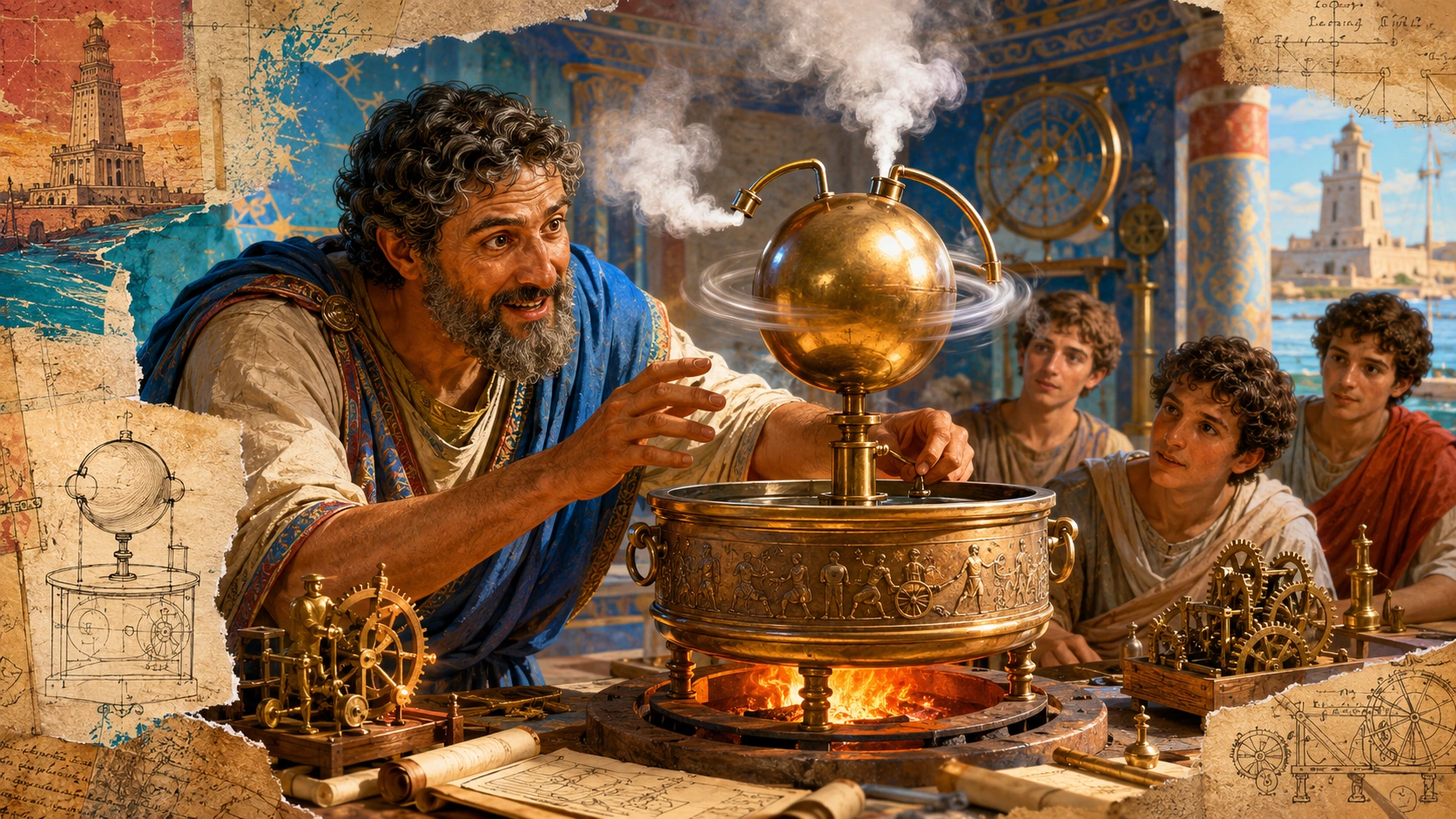
In the first century CE, the engineer Hero of Alexandria described a device now known as the aeolipile. It used steam to spin a hollow sphere. Steam entered through tubes and escaped through bent nozzles, causing the sphere to rotate. Britannica describes it as a steam turbine invented by Hero and explained in his Pneumatica. (Encyclopedia Britannica)
To modern eyes, it looks like the beginning of the steam engine. That makes it tempting to ask why the ancient world did not move straight into factories, railways, and industrial machinery. The answer is that an invention is not the same thing as an industrial system.
Hero’s aeolipile was more of a demonstration than a practical engine. Britannica notes that Hero used his steam device to power toys and amuse visitors, not to run heavy machinery. (Encyclopedia Britannica) It showed a principle, but it did not solve the larger problems of power, fuel, materials, and mechanical transmission.
Ancient societies had different economic pressures. Human and animal labor were widely available. Large-scale industry did not yet have the same need for mechanical power. Metalworking also limited what could be built safely and efficiently.
The aeolipile was not a lost industrial revolution in miniature. It was a brilliant device in the wrong world. The idea of steam power had appeared, but the age of steam still needed many other conditions before it could begin.
The Antikythera Mechanism and the Ancient Computer
In 1901, divers found fragments of a strange geared object in a shipwreck near the Greek island of Antikythera. At first, it was not fully understood. Later research revealed something remarkable. The object was an ancient mechanical calculator for astronomical cycles.
The Antikythera mechanism is often called the world’s first known analog computer. Smithsonian describes it as proof that ancient Greeks used complex arrangements of precisely cut wheels to represent scientific knowledge. (Smithsonian Magazine) The device could model celestial cycles through gears, dials, and inscriptions.
Its sophistication is what makes it so surprising. It was not a simple gadget. It embodied astronomy, mathematics, craftsmanship, and mechanical design. It turned abstract cycles of the heavens into a working machine.
The most striking thing is not only that it existed. It is that similar machines did not become common. For centuries afterward, no known tradition of comparable geared astronomical devices seems to have continued at the same level.
This does not mean the Greeks were modern engineers in disguise. The Antikythera mechanism belonged to a learned world of astronomy, elite patronage, and specialized craftsmanship. It was likely rare and expensive.
Still, it feels strangely modern. It reminds us that ancient technology was not always crude. Sometimes, the past produced objects so advanced that later centuries had to rediscover the path.
Babbage’s Computer Before the Computer Age
In the 19th century, Charles Babbage imagined machines that could calculate with extraordinary precision. His Difference Engine was designed to produce mathematical tables. His later Analytical Engine went further. It was a proposed general-purpose mechanical computer.
The Science Museum explains that Ada Lovelace met Babbage in 1833 and later played an important role in interpreting and publicizing his Analytical Engine. (Science Museum) The Computer History Museum also describes Lovelace’s unusual mathematical education and her connection to Babbage’s work. (CHM)
The Analytical Engine contained ideas that now sound familiar. It would use punched cards. It would have a memory. It would separate storage from processing. It was not just a calculator for one task. It pointed toward programmable computing.
But Babbage lived in a mechanical age. His designs required precision engineering at a level that was expensive and difficult. The machine was too large, too costly, and too ambitious for the institutions that might have supported it.
The story is often told as a tragedy of missed opportunity. That is partly true. Yet the deeper lesson is about timing. Babbage had a concept that belonged to the future, but not the industrial ecosystem needed to make it useful.
The electronic computer would arrive much later. By then, electricity, vacuum tubes, switches, wartime funding, and new mathematical needs had changed the world. Babbage had imagined a door before the building around it existed.
The Fax Machine Before the Telephone
The fax machine feels like a late 20th-century office object. It belongs, in memory, to paper trays, beeping lines, contracts, and corporate routine. Yet the basic idea of sending images over wires is much older than most people assume.
Scottish inventor Alexander Bain received a British patent in 1843 for an early facsimile concept. Later, Giovanni Caselli developed the pantelegraph, which could transmit handwriting and images over telegraph lines. A modern history of fax technology describes Caselli’s commercial service between Paris and Lyon in 1865, before the telephone was patented. (mFax)
That fact alone is startling. People were trying to send documents electronically before ordinary voice calls existed. The pantelegraph was not a toy. It had real uses, especially where signatures, handwriting, and images mattered.
Yet early fax technology had limits. It was slow by modern standards. It required special equipment. It depended on telegraph infrastructure and careful synchronization. It also served a world that still ran on clerks, couriers, ledgers, and physical paperwork.
The idea survived because the need was real. People wanted to move not just words, but documents. The problem was that the wider world needed better networks, cheaper devices, and more reliable electrical systems.
By the time fax machines became office staples, the invention no longer seemed magical. That is often how ahead-of-time technology works. It looks impossible in one century and boring in another.
Edison’s Electric Pen and the Future of Copying
In the 1870s, Thomas Edison created the electric pen. It was not meant as a writing instrument in the ordinary sense. It used a motorized needle to punch tiny holes into a stencil. Ink could then be pressed through the stencil to make copies.
The Henry Ford museum describes Edison’s electric pen as an ancestor of both the mimeograph and the tattoo needle. It notes that users wrote normally while the powered needle created a stencil for duplicating documents. (The Henry Ford)
The invention addressed a real problem. Offices needed copies. Before photocopiers and printers, duplication was slow and laborious. Clerks copied documents by hand, used letterpress methods, or relied on other awkward systems.
The electric pen offered a future in which writing could become mechanically reproducible. It was clever, but it was also noisy, messy, and not easy enough for every office. Like many early devices, it demanded patience from its users.
Its afterlife was unexpectedly important. The Science Museum notes that Edison’s electric pen influenced the development of electric tattoo machines, even though it was not originally patented for that purpose. (Science Museum Blog)
That strange path makes the electric pen especially interesting. It was ahead of its time in one field, then reborn in another. Not every invention reaches the future by the route its maker expected.
Beach’s Pneumatic Subway Under New York
In 1870, New Yorkers could visit an underground railway beneath Broadway. It was not the subway system they know today. It was Alfred Ely Beach’s pneumatic transit project, a short demonstration line powered by air pressure.
The American Physical Society describes February 26, 1870, as the date of New York City’s first pneumatic-powered subway line. (American Physical Society) Wired describes Beach’s project as a 300-foot tunnel under Broadway, with a passenger car pushed by a massive blower. (WIRED)
The idea was elegant and theatrical. Passengers entered through a station and rode a car through a tunnel. The system offered a possible answer to crowded streets filled with horses, carts, pedestrians, and noise.
But Beach’s subway was trapped by politics, finance, and urban power. Wired notes that the project faced political obstacles, property concerns, and the financial panic of 1873. It closed before it could become a full network. (WIRED)
The invention was not absurd. Underground transit later became essential to New York. The problem was that Beach’s version arrived before the city had the political will, financial structure, and engineering consensus to build a true subway system.
When New York’s modern subway began decades later, it used different technology. Still, Beach had understood the future shape of the city. The crowded metropolis would have to move underground.
Why Being Early Can Be a Problem
The phrase “ahead of its time” can make invention sound like a simple contest. One person has an idea. Everyone else fails to understand it. Later generations finally catch up.
Sometimes that happens. But most early inventions fail for more complicated reasons.
A device may need materials that are not yet good enough. It may need roads, wires, factories, skilled mechanics, or mass education. It may need customers who can imagine using it. It may need laws that permit it. It may need investors willing to wait.
Hero’s steam device needed an industrial world. The Antikythera mechanism needed a continuing tradition of precision mechanical astronomy. Babbage’s computer needed better manufacturing and stronger institutional support. Early fax machines needed better networks. Edison’s electric pen needed simpler copying culture. Beach’s subway needed a city ready to build below itself.
These inventions were not failures in the ordinary sense. They were signals. Each one showed that a future possibility had become visible, even if it could not yet become common.
The Future Hidden in Old Machines
Forgotten inventions often feel eerie because they disrupt the usual story of progress. We like to imagine history as a staircase. One step leads neatly to the next. First comes ignorance, then discovery, then improvement.
The real story is messier. Ideas appear, vanish, return, and change shape. A machine can be invented too early. A useful principle can sit unused for centuries. A failed device can inspire a later industry in a different form.
That does not make the original inventors prophets. They were people working within the limits of their own time. They had ambitions, mistakes, patrons, debts, rivals, and blind spots. Their inventions were not magic glimpses of destiny.
Still, they remind us that the past was full of unrealized futures. Some were impossible. Some were impractical. Some were simply waiting for the rest of the world to catch up.
The most fascinating forgotten inventions are not just clever objects. They are evidence that history could have moved differently. They show us moments when the future briefly appeared, then slipped away, leaving behind a machine, a patent, a fragment, or a story that later generations would finally understand.
Style and structure followed the uploaded article brief.