
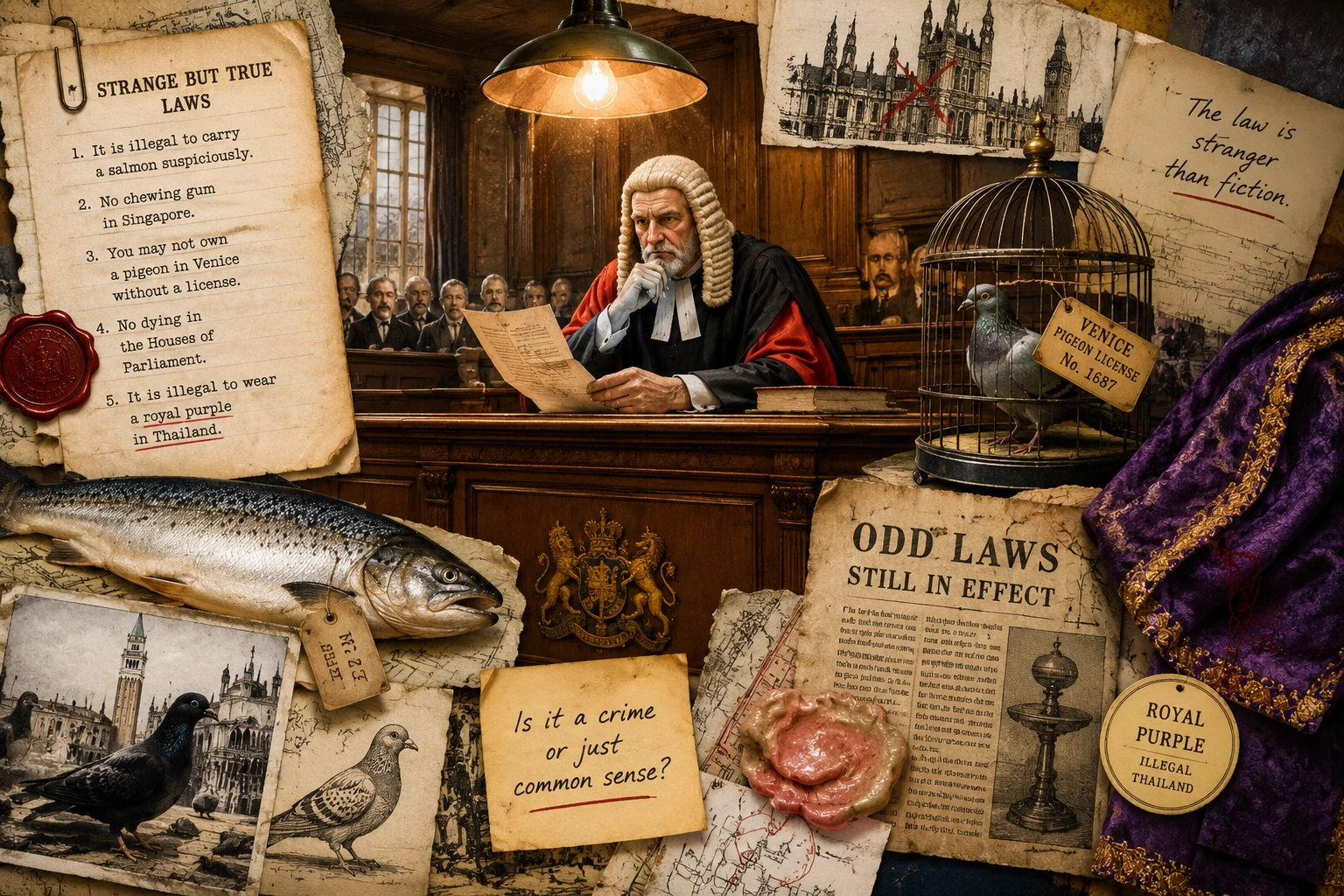
The Weirdest Laws in History, and a Few That Still Exist Today
Laws are usually remembered as serious things. They define crimes, settle disputes, protect property, raise taxes, and give governments their power. Yet the legal past is also full of rules that now seem strange, comic, cruel, or almost impossible to explain.
Some were never as ridiculous as they sound. Some made sense in a world shaped by religion, disease, class, agriculture, and fear. Others were old rules that survived long after their original purpose faded. A few still exist today, although they are often misunderstood when shared online as “weird laws.”
The strangest laws are rarely random. They usually reveal what a society worried about. They show what people wanted to control, what they feared losing, and what they believed order should look like.
When Clothes Were a Legal Matter
For much of history, clothing was not just a private choice. It was a public sign of rank. In many societies, rulers tried to control who could wear certain fabrics, colors, jewels, and styles.
These rules are known as sumptuary laws. They appeared in different forms across Europe, Asia, and elsewhere. Their purpose was not only to stop luxury spending. They were also meant to keep social classes visible.
In medieval and early modern Europe, the wrong sleeve, fur, or embroidery could be treated as a threat to order. A merchant might be wealthy enough to dress like a noble. That worried elites. Clothing could blur the social lines that law and custom were trying to preserve.
England passed several sumptuary laws over the centuries. Some restricted the use of costly cloth, imported goods, or certain decorations. These laws were hard to enforce, but they show how seriously appearance mattered.
To modern eyes, it seems odd that a government would care about velvet trim or gold thread. Yet in a society built on hierarchy, clothing was not small. It was a language of power.
A person’s outfit could announce rank before a word was spoken. Controlling clothing meant controlling how society saw itself.
The Laws Against Too Much Fun
Religious authorities and governments have often tried to regulate leisure. This could mean gambling, dancing, drinking, festivals, theater, music, sports, or even holiday celebrations.
One famous example comes from Puritan England. In the 1640s, during the English Civil War period, Parliament moved against Christmas celebrations. Traditional Christmas customs included feasting, drinking, games, decorations, and public merriment. Puritan reformers viewed many of these customs as disorderly and unbiblical.
The result was not a simple ban on belief. It was a fight over culture. For many ordinary people, Christmas was part of the yearly rhythm. For reformers, it represented excess, superstition, and Catholic influence.
Laws of this kind remind us that “fun” has often been political. Public celebration can bring people together, but it can also worry authorities. Crowds drink, mock leaders, cross class boundaries, and behave in ways that feel hard to govern.
That is why festivals were often watched closely. A dance, a costume, or a feast could seem harmless to participants. To rulers, it might look like disorder waiting to happen.
The Crime of Being Dressed Wrong
Some strange laws were aimed at identity itself. Across history, governments used clothing rules to enforce religion, class, gender, and ethnic difference.
In some places, minority groups were required to wear identifying garments or marks. These laws were not amusing oddities. They were tools of control and humiliation. They made difference visible by force.
Other laws punished people for wearing clothes associated with a different gender. Such rules existed in many legal and religious traditions. They were usually tied to fears about social order, morality, inheritance, and public decency.
Modern readers sometimes treat old clothing laws as quaint. But many were serious. They could restrict movement, mark people as outsiders, and make punishment easier.
The strangeness of these laws comes from how deeply they entered ordinary life. They did not only govern courts or kings. They governed sleeves, hats, shoes, veils, colors, and bodies.
Animal Trials and the Law’s Strange Imagination
One of the most unusual legal practices in medieval and early modern Europe was the animal trial. In some places, animals were formally accused of crimes. Pigs, rats, insects, and other creatures could be brought into legal proceedings.
The most famous examples involve pigs accused of killing children. A pig might be tried, sentenced, and executed. Other cases involved pests, such as rats or insects, being summoned in legal language.
These trials seem absurd now. Yet they belonged to a world where law, religion, symbolism, and community order were closely linked. A violent death caused by an animal still demanded public explanation. A trial could turn chaos into ritual.
Not every story about animal trials is equally reliable. Some later writers exaggerated them. Still, enough records exist to show that such proceedings did occur in certain places.
The practice reveals a very different legal imagination. Law was not only about private guilt in the modern sense. It was also about restoring moral order after something frightening happened.
A pig could not understand a courtroom. But the community could understand a sentence.
Laws Against Luxury at the Table
Food has also been a legal target. In many societies, rulers tried to control what people ate, how much they served, or how expensive feasts could become.
These laws often appeared during periods of anxiety. Authorities worried that banquets encouraged waste, pride, debt, or social competition. A noble family might host an extravagant feast to display wealth. A rising merchant might do the same to claim status.
Some food laws were tied to religion. Others were tied to class. Still others were tied to shortage. During famine or war, rules about grain, meat, bread, and alcohol could become matters of survival.
What seems strange is not that governments regulated food. Many still do. What seems strange is how moral the issue could become. A feast could be treated as a public statement. Too much spice, meat, or ceremony could look like arrogance.
Food was never just food. It showed who had land, money, servants, trade connections, and social ambition.
The Famous Salmon Law That Sounds Stranger Than It Is
One of the most quoted weird laws in Britain is the rule about handling salmon “in suspicious circumstances.” It sounds almost like a comedy sketch. The phrase alone makes people imagine someone lurking in an alley with a nervous fish.
The real law is less silly. Section 32 of the Salmon Act 1986 created an offence involving fish when a person believes, or could reasonably suspect, that a relevant offence has taken place. In plain terms, it is about illegally taken fish and the trade connected to poaching. (Legislation.gov.uk)
This is a good example of a law that sounds ridiculous when removed from context. The phrase is funny. The purpose is ordinary. Governments have long tried to regulate fishing, protect stocks, and punish illegal trade.
The salmon law still gets shared because it has the perfect ingredients for a weird-law list. It is real, oddly worded, and easy to misunderstand.
Yet it is not a medieval leftover. It is a modern statute with a practical purpose. The strangeness comes mostly from legal phrasing.
Singapore’s Chewing Gum Rules
Singapore is often said to have “banned chewing gum.” That is partly true, but the simple version misses the details.
Singapore’s rules restrict the import and sale of chewing gum, with exceptions. The official regulations state that, except in allowed cases, importing chewing gum into Singapore is prohibited. (Singapore Statutes Online) The National Library Board of Singapore explains that the ban dates to 1992 and covers importing, selling, and manufacturing gum, with later exceptions for therapeutic types. (NLB)
The law is often treated as bizarre because chewing gum seems trivial. But the background was practical. Officials were concerned about gum being stuck in public places, including parts of the mass transit system.
Whether one sees the rule as sensible or excessive, it reflects Singapore’s larger approach to public order. Cleanliness, efficiency, and civic discipline have been central themes in its modern governance.
The chewing gum rule survives because it is more than a rule about gum. It is part of a broader idea of how public space should function.
Venice and the Pigeons
Venice has many rules aimed at protecting a fragile city under heavy tourist pressure. One of the best known is the ban on feeding pigeons in and around St. Mark’s Square.
The rule took effect in 2008. Reuters reported at the time that Venice had made feeding pigeons in St. Mark’s Square illegal, ending a long tourist tradition. (Reuters) More recent travel reporting describes the ban as part of a wider set of rules intended to protect historic spaces, public health, and local life. (The Washington Post)
At first, this sounds like an oddly specific law. But Venice is not an ordinary city. Its monuments, stonework, crowds, canals, and narrow public spaces are under constant pressure.
Pigeons may look harmless in photographs. In large numbers, they damage buildings and create sanitation problems. A law that seems fussy from a distance can look different in a city trying to protect centuries-old architecture.
The pigeon ban shows how modern “weird laws” often come from tourism. When millions of visitors treat a place like a backdrop, local governments start regulating small acts.
Canada’s Limits on Paying With Coins
Another real law that sounds like trivia concerns coins in Canada. Many people assume legal tender means a person can pay any amount with any official money. That is not quite right.
Canada’s Currency Act sets limits on how much can be paid in coins of different denominations. The official law states that legal tender in coins is limited by denomination and amount. For example, payment in certain coins is only legal tender up to specified values. (Department of Justice Canada) The Royal Canadian Mint also points people to Section 8 of the Currency Act when explaining limits on coin payments. (https://www.mint.ca/en-us)
This law can sound strange because coins are money. But the purpose is practical. Without limits, someone could try to settle a large debt with a mountain of small change.
The law is not really about being quirky. It is about making payment workable. Legal tender rules often have more nuance than people expect.
A coin can be valid money and still not be usable in unlimited quantities for every payment.
The Mythical Laws That Probably Are Not Laws
No subject attracts false claims quite like weird laws. The internet is full of lists saying it is illegal to do ordinary things in strange places. Many are exaggerated, outdated, mistranslated, or simply invented.
One famous example is the claim that it is illegal to flush a toilet after 10 p.m. in Switzerland. There is no national Swiss law that says this. In some apartment buildings, noise rules or lease customs may discourage loud plumbing late at night. That is very different from a countrywide criminal law.
These myths spread because they sound believable enough. They also flatter the reader. The past, or another country, becomes the strange place. The person reading gets to feel modern and sensible.
Real weird laws are more interesting than fake ones. They have context. They tell us about property, power, fear, sanitation, religion, class, or public order.
A fake law is only a joke. A real strange law is a doorway.
Why Strange Laws Survive
Some odd laws survive because no one bothers to remove them. Legal systems can be crowded with old statutes, local ordinances, and technical rules. A law may remain on the books even if it is rarely enforced.
Others survive because they still serve a purpose. The wording may sound funny, but the logic remains practical. The salmon law protects against illegal fishing. Coin limits prevent unreasonable payments. Pigeon rules protect fragile public spaces.
Some laws survive as symbols. They show what a community values, even when enforcement is limited. A city that bans certain tourist behavior is making a statement about ownership, respect, and preservation.
The weirdest laws often sit between past and present. They can be old rules in modern books. They can be modern rules with old-fashioned wording. They can be serious laws that sound absurd when quoted without explanation.
That is why they are worth reading carefully. They show that law is not only a system of punishment. It is a record of anxiety.
A society writes laws around the things it wants to protect. Sometimes that means land, money, religion, class, or public safety. Sometimes it means velvet sleeves, Christmas feasts, salmon, pigeons, coins, or gum.
The strange laws of history are not just legal curiosities. They are small windows into the worlds that created them. They show how people tried to make order out of daily life, even when the result now seems wonderfully odd.
Style and structure followed the uploaded article brief.