
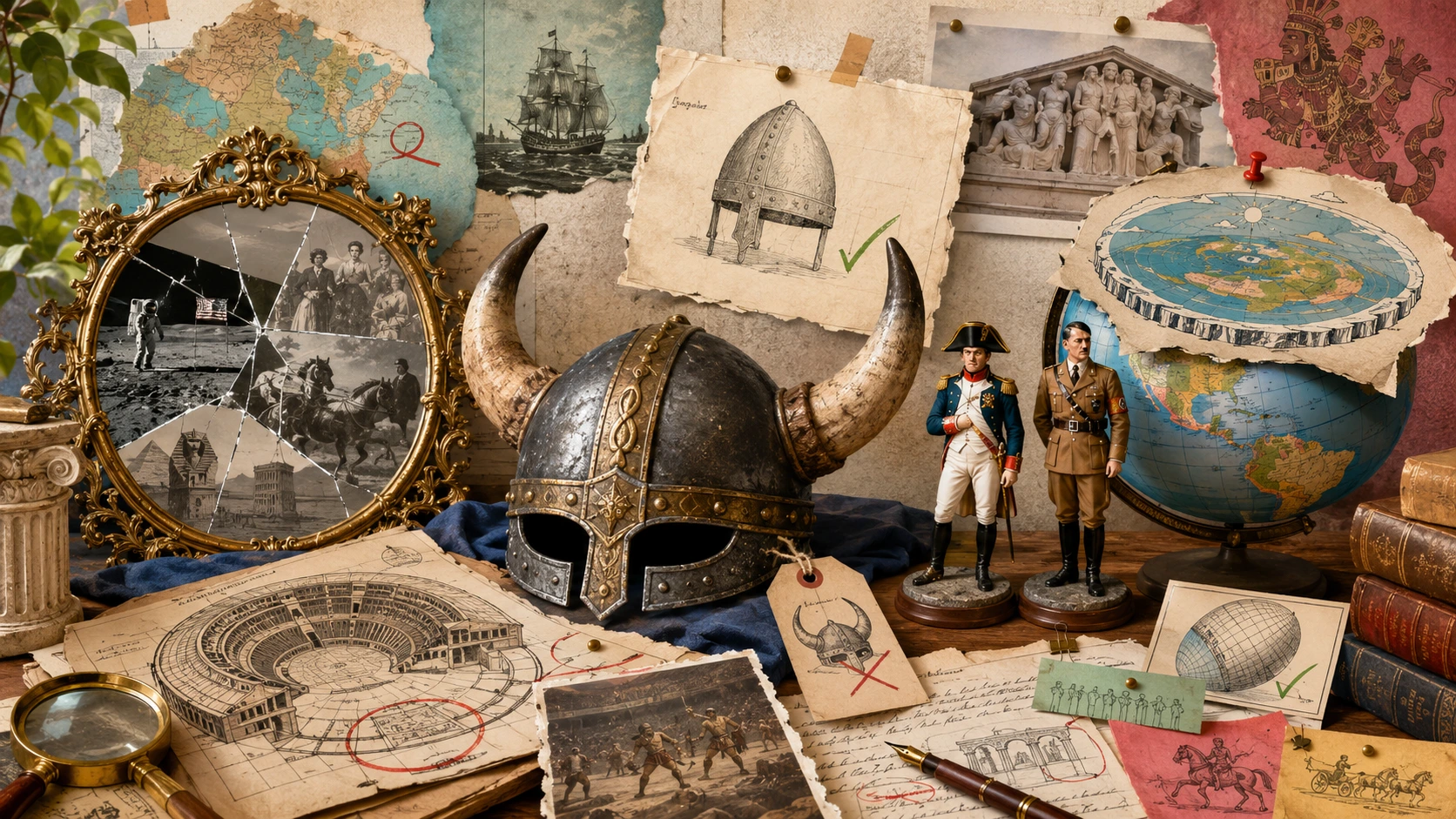
Historical “Facts” Most People Believe That Are Actually Wrong
History is full of stories that feel too familiar to question. They appear in school lessons, films, trivia books, museum tours, and casual conversation. After a while, they become part of the background. Everyone has heard them, so they start to feel true.
The problem is that many of these “facts” are not quite facts at all. Some began as jokes. Some came from propaganda. Some were simplified until they became misleading. Others contain a small piece of truth, but the popular version has grown far beyond the evidence.
Misconceptions about history are not always harmless. They shape how people imagine the past. They can make earlier societies seem foolish, cruel, primitive, or strange in ways that are not accurate. They can also hide the real complexity of people’s lives.
The truth is often more interesting than the myth. It is usually less neat, but more human. History rarely fits into a single dramatic sentence.
Vikings Did Not Wear Horned Helmets
The horned Viking helmet is one of the most famous images in popular history. It appears in cartoons, costumes, sports mascots, and fantasy films. It is so recognizable that many people assume it must be based on real Viking warriors.
It is not.
There is no good evidence that Viking fighters wore horned helmets in battle. Actual helmets from the Viking Age were practical objects. A warrior needed protection, not decoration that could catch a weapon or make movement harder.
The famous horned image became popular much later. In the 19th century, artists and stage designers helped create a dramatic version of the Viking past. Opera costumes and romantic paintings made Vikings look wild, ancient, and almost mythical.
That image was powerful. It stayed in the public imagination because it was simple and memorable. A plain iron helmet did not have the same theatrical effect.
The myth tells us more about modern fantasy than about Viking life. Vikings were raiders, traders, settlers, farmers, sailors, and craftspeople. Their world was complex. The horned helmet turns them into a symbol instead of a society.
Napoleon Was Not Especially Short
Napoleon Bonaparte is often remembered as a tiny man with an enormous ego. The phrase “Napoleon complex” still suggests that short men may overcompensate through ambition or aggression. It is one of the most stubborn ideas attached to any historical figure.
Yet Napoleon was not unusually short for his time.
Part of the confusion comes from measurement. French inches and British inches were not the same. When Napoleon’s height was recorded in French units, later readers sometimes misunderstood the number. His reported height was about average for a Frenchman of his era.
The myth was also helped by British propaganda. Napoleon’s enemies had every reason to make him look ridiculous. Political cartoons often showed him as small, angry, and childish. This was not careful biography. It was mockery.
There was another reason the image stuck. Napoleon was often seen near members of his Imperial Guard. These men were chosen partly for their height. Standing beside tall soldiers could make him seem smaller than he was.
The real Napoleon does not need the myth to be interesting. His rise from Corsican outsider to emperor is dramatic enough. Reducing him to a short-man stereotype makes the history less accurate and less useful.
People in the Middle Ages Did Not Think the Earth Was Flat
One of the most common myths about the Middle Ages is that educated people believed the Earth was flat. According to the familiar story, medieval Europeans lived in ignorance until brave modern thinkers finally proved the planet was round.
That story is mostly wrong.
Educated people in medieval Europe generally knew the Earth was spherical. This idea had been discussed since ancient Greece. Medieval scholars inherited many ancient texts and added their own commentaries. The round Earth appeared in learned writing, astronomy, and theology.
This does not mean everyone understood the globe in a modern scientific way. Many ordinary people may not have thought much about the shape of the planet at all. But the idea that medieval scholars believed in a flat Earth is a later invention.
The myth became popular in the 19th century. Some writers used it to create a dramatic story about science defeating religion. It was a useful contrast, but it was not fair to the actual Middle Ages.
The real disputes were often more complicated. People argued about geography, scripture, astronomy, and the size of the known world. They did not simply sit around believing the planet was a flat board.
This myth matters because it makes the medieval past look much stupider than it was. Medieval people lacked many modern tools, but they were not incapable of careful thought.
Marie Antoinette Probably Never Said “Let Them Eat Cake”
Few historical quotes are as famous as “Let them eat cake.” It is usually linked to Marie Antoinette, queen of France during the French Revolution. The quote is used to show how out of touch she was with ordinary people.
The trouble is that she probably never said it.
The phrase existed before Marie Antoinette became queen. A similar line appears in the writings of Jean-Jacques Rousseau. He attributed it to a “great princess,” but he did not name Marie Antoinette. At the time Rousseau wrote it, she was still a child.
The quote became attached to her because it fit a political image. During the Revolution, Marie Antoinette was hated by many in France. She was seen as foreign, extravagant, and careless. Stories about her cruelty or stupidity spread easily.
That does not mean she was a simple victim of slander. The French monarchy was deeply unequal. The royal court did live with extraordinary privilege. Many people had good reason to resent it.
Still, the famous quote is almost certainly not evidence of her personal words. It is evidence of how political hatred works. A story can become believable when it expresses what people already feel.
The myth survives because it is tidy. It turns a complicated crisis into one arrogant sentence.
Roman Vomitoriums Were Not Rooms for Vomiting
The word “vomitorium” sounds like it should describe a room where Romans went to vomit during enormous feasts. This idea appears often in popular writing. It fits the image of Rome as decadent, excessive, and morally rotten.
But a vomitorium was not a vomiting room.
In Roman architecture, a vomitorium was a passageway in a stadium, theater, or amphitheater. It allowed crowds to enter and exit quickly. The word comes from the idea of people being “spewed out” into or from a large public space.
Romans did hold lavish banquets, especially among the wealthy. Some elite dining habits could be extravagant. But the special vomiting room is not a real feature of Roman domestic life.
The myth grew because it matched an older moral story about Rome. For centuries, writers used Rome as an example of luxury leading to decline. The imagined vomitorium made that story vivid. It was disgusting, memorable, and easy to repeat.
The truth is less scandalous, but still interesting. Roman engineering was excellent at managing crowds. Their public buildings were designed with movement in mind. The real vomitorium belongs to the history of architecture, not the history of gluttony.
Iron Maidens Were Probably Not Medieval Torture Devices
The iron maiden is one of the most famous torture devices in the world. It is usually shown as a tall metal cabinet shaped like a human body. Inside are spikes that supposedly pierced the victim when the door closed.
It looks medieval. That is part of the problem.
Most historians believe the iron maiden, as commonly imagined, was not a real medieval torture device. The best-known examples seem to be much later creations. They were likely assembled or promoted in the 18th and 19th centuries, when museums and exhibitions displayed shocking objects for curious visitors.
This does not mean medieval and early modern punishment was gentle. Torture and public execution were real. Courts and rulers could be brutal. But not every famous torture object is authentic.
The iron maiden became popular because it suited a modern taste for gothic horror. It gave visitors a physical object that seemed to prove how savage the past had been. It also made the Middle Ages look dark, irrational, and cruel in a simple way.
The real history of punishment is harder to face. It involved law, power, religion, public spectacle, and social control. A fake or exaggerated device can distract from the violence that actually existed.
Witches Were Not Usually Burned in Salem
The Salem witch trials are often remembered with the image of women being burned at the stake. It is a powerful image, and it appears often in films and popular discussion.
But in Salem, the convicted were not burned. They were hanged.
The Salem trials took place in colonial Massachusetts in 1692 and 1693. Nineteen people were executed by hanging. One man, Giles Corey, was pressed to death after refusing to enter a plea. Others died in jail.
Burning was used in some European witch trials. It was more common in certain legal traditions on the continent. English law, which shaped colonial Massachusetts, treated witchcraft differently. Hanging was the usual punishment.
The confusion may come from combining different histories. European witch hunts, medieval heresy trials, and Salem have often been blended into one general image of persecution. The result is emotionally powerful, but historically messy.
The truth does not make Salem less terrifying. It was still a deadly panic. Accusations spread through fear, local conflict, religious anxiety, and fragile legal standards. People died because their neighbors and courts believed impossible claims.
Getting the method of execution right is not a small detail. It helps place Salem in its own legal and cultural world.
Gladiator Fights Were Not Always Fights to the Death
Popular culture often shows Roman gladiators entering the arena with only two possible outcomes. One man survives. The other dies. The crowd cheers, and the emperor gives a thumb signal.
Reality was more complicated.
Gladiators were expensive to train, feed, house, and promote. Many were enslaved, condemned, or socially marginalized, but they were still valuable property. Owners did not always want them killed after one fight.
Some bouts did end in death. The arena could be brutal. Injuries were serious, and executions were staged as public entertainment. But many gladiator fights ended when one fighter surrendered or was judged defeated.
The famous thumb gesture is also uncertain. Ancient sources mention hand signals, but the exact meaning of the gestures is debated. Modern films have made one version feel certain, even though the evidence is not that simple.
Gladiators occupied a strange place in Roman society. They were often dishonored, yet some became celebrities. Crowds admired their courage and skill. Their lives were controlled, dangerous, and public.
The myth of constant death makes the arena seem like pure chaos. The real system was more organized, commercial, and ritualized. That may make it even more unsettling.
Medieval People Did Not All Die at Thirty
The idea that medieval people usually died around age thirty is based on a misunderstanding of life expectancy. It is true that average life expectancy at birth was much lower than it is today. But that does not mean most adults dropped dead at thirty.
The average was pulled down by high infant and child mortality. Many children died from disease, poor nutrition, infection, accidents, or complications around birth. When many people die very young, the average age of death becomes low.
A person who survived childhood could often live into middle age or old age. Not everyone did, of course. War, childbirth, plague, famine, and infection were serious dangers. Life was more fragile than it is in many modern societies.
But medieval communities included elders. They had grandparents, widows, experienced craftspeople, older monks, senior officials, and aging peasants. The past was not populated only by teenagers and thirty-year-olds.
This misconception matters because it changes how we imagine people’s lives. Medieval adults made long-term plans. They inherited land, trained apprentices, raised families, entered old age, and remembered earlier generations.
A low average does not describe every individual life. It describes the harsh arithmetic of survival.
Why Historical Myths Last So Long
Historical myths survive because they are useful. They simplify. They entertain. They create villains, heroes, and punchlines. They make the past easier to picture.
They also survive because they often contain a feeling that seems true. Marie Antoinette did live in a world of privilege. Rome did have elite excess. Salem was a real tragedy. Medieval medicine could be dangerous. Vikings really were fierce raiders in some contexts.
But a feeling is not the same as a fact. A myth can point toward a real historical theme while still getting the details wrong.
The better version of history is not always as easy to remember. It asks for patience. It includes uncertainty. It admits that people acted within systems of belief, law, class, religion, and technology that were different from our own.
That does not make the past less strange. It makes it stranger in a more honest way. The real past is not a collection of neat trivia answers. It is a world of people trying to live with the knowledge, fears, customs, and pressures they had.
The most familiar historical “facts” often tell us as much about later imagination as they do about earlier events. When a myth is corrected, something valuable happens. The past becomes less like a cartoon and more like a place people actually lived.