
The Strangest Jobs People Had in the Past
Some of the strangest jobs in history were not strange to the people who performed them. They were ordinary answers to ordinary problems: how to wake workers before alarm clocks were cheap, how to light a dark street before electric lamps, how to supply doctors with leeches, how to provide anatomy schools with bodies, or how to turn the waste of a crowded city into useful material.
What makes these occupations feel so odd now is not simply that they were unpleasant or dangerous. It is that they reveal how much daily life once depended on human labor in places where machines, regulations, sanitation systems, and modern medicine had not yet taken over. The forgotten workers of the past often stood in the gap between a need and an invention.
The Human Alarm Clocks of Industrial Britain
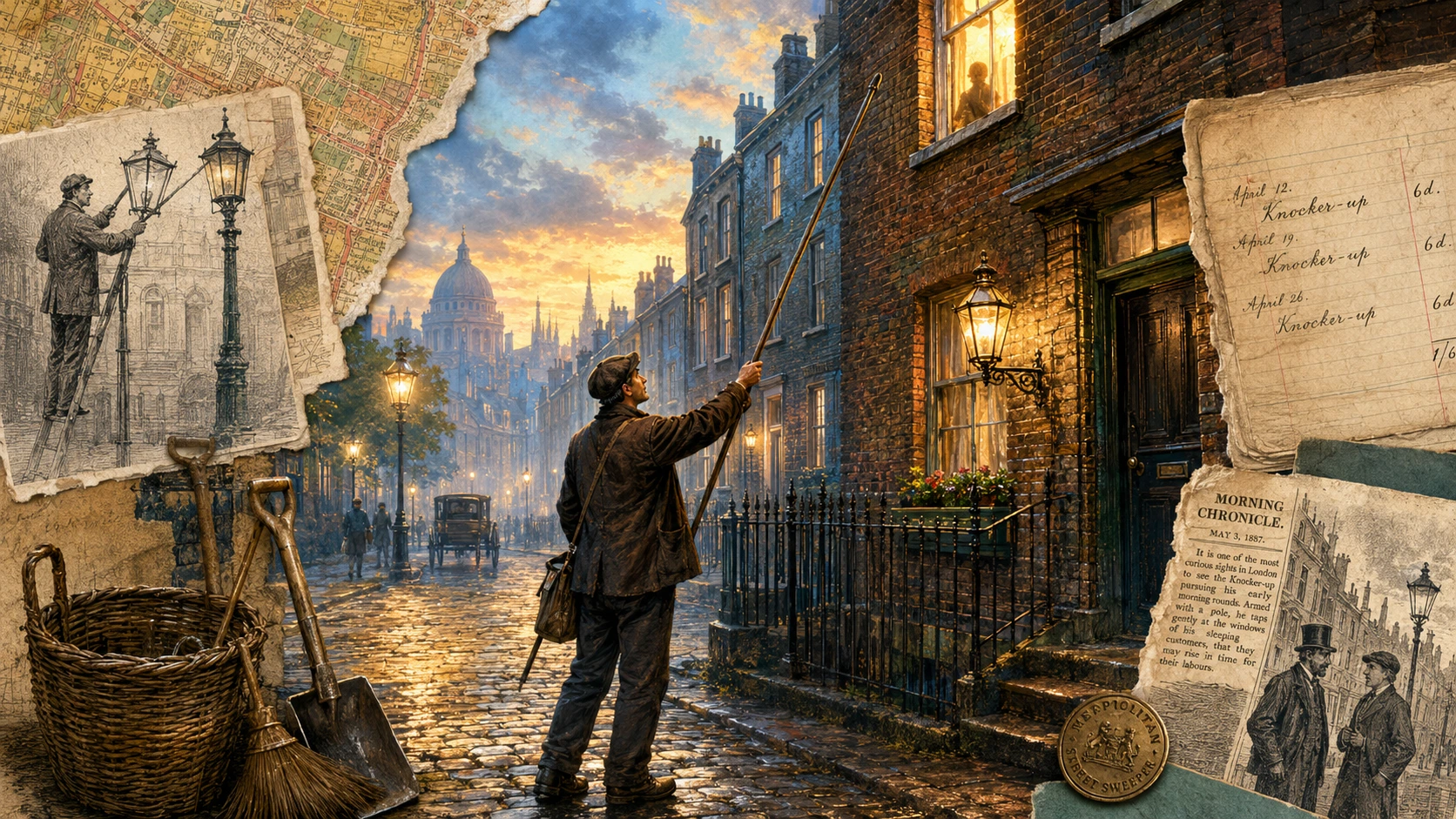
In the industrial towns of Britain and Ireland, punctuality became a matter of survival. Factory bells, shift work, mills, mines, and docks all demanded that workers rise by the clock rather than by daylight. Yet reliable alarm clocks were not always affordable for working families. The solution was the knocker-up, a person paid to wake others before dawn.
A knocker-up might tap on a door with a short stick or use a long pole to reach an upstairs window. Some accounts describe pea-shooters used to rattle dried peas against glass. The point was not to wake the whole street, only the paying customer. A worker who missed a shift could lose wages, so a few pence a week for a human alarm clock could be worth the cost. (JSTOR Daily)
The job belonged to the world created by the Industrial Revolution. Before industrial labor, many people’s work followed more flexible rhythms of season, daylight, household production, and local custom. Factory work narrowed those rhythms into strict hours. The knocker-up was not just a quaint figure with a stick. He or she was part of a new economy in which time itself had become a discipline.
The work also shows how invention rarely changes life all at once. Alarm clocks existed, but they were not immediately universal. For a long time, old and new systems overlapped. People used clocks, factory bells, church bells, neighbors, family members, and paid wake-up callers. The knocker-up survived because industrial modernity arrived unevenly, especially among the poor.
Link-Boys and the Problem of Darkness
Before modern street lighting, night in a city was a different kind of place. Streets could be muddy, uneven, poorly marked, and dangerous. In London and other cities, people who needed to move after dark might hire a link-boy, usually a poor boy or young man, to carry a torch and guide the way.
The “link” was a torch, often made with material soaked in pitch or fat. The link-boy’s job was practical, but it also belonged to a shadowy economy of trust. A hired guide could keep a traveler from stumbling through dark lanes, but some had reputations for leading customers toward thieves. Whether that danger was common or exaggerated, the fear itself tells us something about night travel before reliable public lighting. (JSTOR Daily)
The link-boy was a human streetlamp. His existence reminds us that darkness once required labor. Today, light appears at the touch of a switch or through a grid of municipal planning. In the past, illumination had to be carried by hand. It smelled, smoked, cost money, and depended on someone poor enough to stand outside at night holding flame for someone richer.
When gas lighting spread through many cities in the 19th century, the need for link-boys declined. The disappearance of the job was not only a technological change. It altered the social experience of the city. Streets became easier to police, shops stayed active later, pedestrians moved differently, and darkness slowly lost some of its old authority.
The Pure-Finders of Victorian London
Among the most unpleasant forgotten jobs of Victorian London was that of the pure-finder. Despite the delicate name, “pure” meant dog dung. Pure-finders collected it from the streets and sold it to tanneries, where it was used in leather processing.
The work was part of a vast informal recycling economy. Henry Mayhew, whose London Labour and the London Poor remains one of the most important records of Victorian street labor, described pure-finders among the many poor Londoners who survived by gathering what others ignored or discarded. The work was dirty, but it was not pointless. Tanneries needed materials that could help prepare fine leather, including leather used for gloves, bookbinding, and other goods. (dl.tufts.edu)
Victorian London was crowded with horses, dogs, markets, slaughterhouses, ash, mud, sewage, and industrial waste. Much of what modern cities remove through sanitation departments was then handled by low-paid scavengers. Bone grubbers, rag pickers, mudlarks, dustmen, night-soil collectors, and pure-finders all turned refuse into income.
The pure-finder’s job seems disgusting now, and it was hardly pleasant then. Yet it existed because waste had value. Before synthetic chemicals and modern industrial processing, many trades depended on organic materials that came from the street, the stable, the kitchen, or the slaughterhouse. The poor became the city’s unofficial sorting system.
Leech Collectors and the Medical Marketplace
The leech collector’s work sounds like something invented for a nightmare, but it was a real occupation supported by mainstream medicine. For centuries, bloodletting was used to treat illness, and in the late 18th and 19th centuries medicinal leeches became especially fashionable in parts of Europe and North America.
Doctors and apothecaries needed a steady supply. Collectors gathered leeches from ponds, marshes, and wetlands, sometimes using animals as bait. In poorer settings, people might use their own legs, standing in water until leeches attached themselves. The work was uncomfortable and risky, but demand could be enormous. At the height of the 19th-century leech craze, millions of leeches moved through medical markets. (Science History Institute)
This occupation makes more sense when seen through the medical theories of its time. Many physicians believed illness came from imbalances, inflammation, or excesses that could be relieved by removing blood. Leeches offered a controlled and seemingly gentle form of bleeding. They could be placed on parts of the body where a lancet was difficult or dangerous to use.
The leech collector stood at the bottom of a medical system that included physicians, pharmacists, merchants, importers, and patients. The collector’s body absorbed the unpleasant part of the process. While doctors discussed theory and patients hoped for relief, someone had to wade through marshland and gather the living instruments.
The decline of leech collecting came through several forces at once. Medical thinking changed, wetlands were drained, wild leech populations suffered from overharvesting, and mechanical substitutes appeared. Yet leeches never vanished completely from medicine. In modern reconstructive surgery, they are sometimes used to help with blood flow after delicate procedures, a reminder that an old practice can disappear as a theory while surviving as a tool. (Science History Institute)
Resurrection Men and the Price of Anatomy
Some old jobs were strange because they were dirty or exhausting. Others were strange because they lived close to crime. The resurrection men of Britain and Scotland occupied that darker category. They dug up recently buried bodies and sold them to anatomy schools.
The trade grew from a grim imbalance. Medical education needed human bodies for dissection, but the legal supply was limited. In early 19th-century Scotland, for example, bodies available for dissection came from restricted categories such as executed criminals, suicides, prisoners, foundlings, and orphans. Demand from anatomy schools exceeded supply, especially in Edinburgh, a major center of medical study. (abdn.ac.uk)
Resurrection men usually did not steal valuables from graves, since that could bring harsher charges. The body itself occupied a strange legal and moral space. Families feared not only theft, but posthumous humiliation. The idea that a loved one might be taken from the grave and cut open before students was horrifying, especially in a society where burial carried deep religious and emotional meaning.
The fear changed burial practices. Families watched graves. Iron cages called mortsafes were placed over coffins. Watchmen guarded cemeteries. Anatomy schools, meanwhile, continued to need cadavers. The result was an underground market created by law, science, poverty, and desperation.
The notorious Burke and Hare murders in Edinburgh in 1828 showed where that market could lead. Burke and Hare did not merely rob graves. They murdered people and sold the bodies for dissection. Their crimes shocked the public and helped intensify debate over the supply of bodies for medical education, contributing to the Anatomy Act of 1832. (Wikipedia)
The resurrection men reveal an uncomfortable truth about medical progress. Scientific knowledge has often depended on bodies supplied by people with little power, whether criminals, the poor, the institutionalized, or the socially marginal. The job was not just macabre. It exposed a conflict between public horror and professional need.
Why These Jobs Existed
It is easy to laugh at old occupations because they sound absurd from a modern distance. Yet most of them were practical responses to real conditions. The knocker-up existed because punctual industrial labor arrived before cheap personal alarm clocks. The link-boy existed because darkness was a public problem before modern lighting. The pure-finder existed because waste had commercial value in an urban economy with limited sanitation. The leech collector existed because medical theory created demand for living bloodletting tools. The resurrection man existed because anatomy advanced faster than the laws governing cadavers.
These jobs also show how much of history was physically intimate in ways modern life often hides. People handled waste directly. They carried flame through streets. They woke strangers by tapping on their windows. They stood in marshes to attract parasites. They guarded graves against theft. Work was often closer to the body, to danger, and to the raw materials of life and death.
The disappearance of such jobs was rarely caused by a single invention. It came through overlapping changes: electric lighting, affordable clocks, public sanitation, medical reform, chemical processing, new laws, changing beliefs, and different expectations of safety. When those systems matured, the old workers became unnecessary, or at least less visible.
Their stories matter because they make the past feel less abstract. History is not only kings, wars, inventions, and laws. It is also the person with a pole in the dark morning, the child carrying a torch, the old woman searching the street for something a tannery would buy, the marshland laborer gathering leeches, and the grave robber working by night because medicine had created a market for the dead.
The strangest jobs of the past were often strange only because they belonged to worlds that solved problems by hand. They remind us that every convenience has a history, and that many modern comforts were preceded by someone else’s difficult, dirty, dangerous work.